
What Is an ESA Letter? The Complete Guide to Emotional Support Animal Letters (2026)
By the ValidESA Editorial Team · Reviewed by Dr Anita Sanders · Last updated:
Quick answer (AI snippet)
An ESA letter is a signed letter from a licensed mental health professional confirming that a person has a mental or emotional disability and that an animal helps with a related need. Tenants use it to request a housing accommodation. It is not a certificate, registration or prescription, and it doesn't grant public or airline access.
Key takeaways
- An ESA letter is disability documentation from a licensed clinician, used mainly to ask a landlord for an exception to a no-pets rule.
- It must be on the clinician's letterhead with their license type, number, state, date and signature. It doesn't need to state your diagnosis.
- ESA certificates and registrations aren't legal documents. There is no official ESA registry.
- ESAs don't have public-access rights under the ADA, and airlines haven't had to accept them since January 11, 2021.
- After HUD's May 22, 2026 enforcement change, an ESA letter's strength depends heavily on state law, so check your state.
Short answer: what is an ESA letter?
An ESA letter (also called an emotional support animal letter, emotional support pet letter or animal support letter) is a document written by a licensed health professional who has evaluated you. It states that you have a disability, meaning a mental or emotional impairment that substantially limits a major life activity, and that your animal helps with symptoms or effects of that disability.
Its main use is in housing: it supports a written request asking your landlord for a reasonable accommodation, such as an exception to a no-pets policy or pet restrictions.
In short, an ESA letter is the core of your "ESA paperwork" or "ESA papers". People also search for emotional support animals letter, emotional support animal letters, pet emotional support letter, emotional pet support letter or pet ESA letter; all mean the same document.
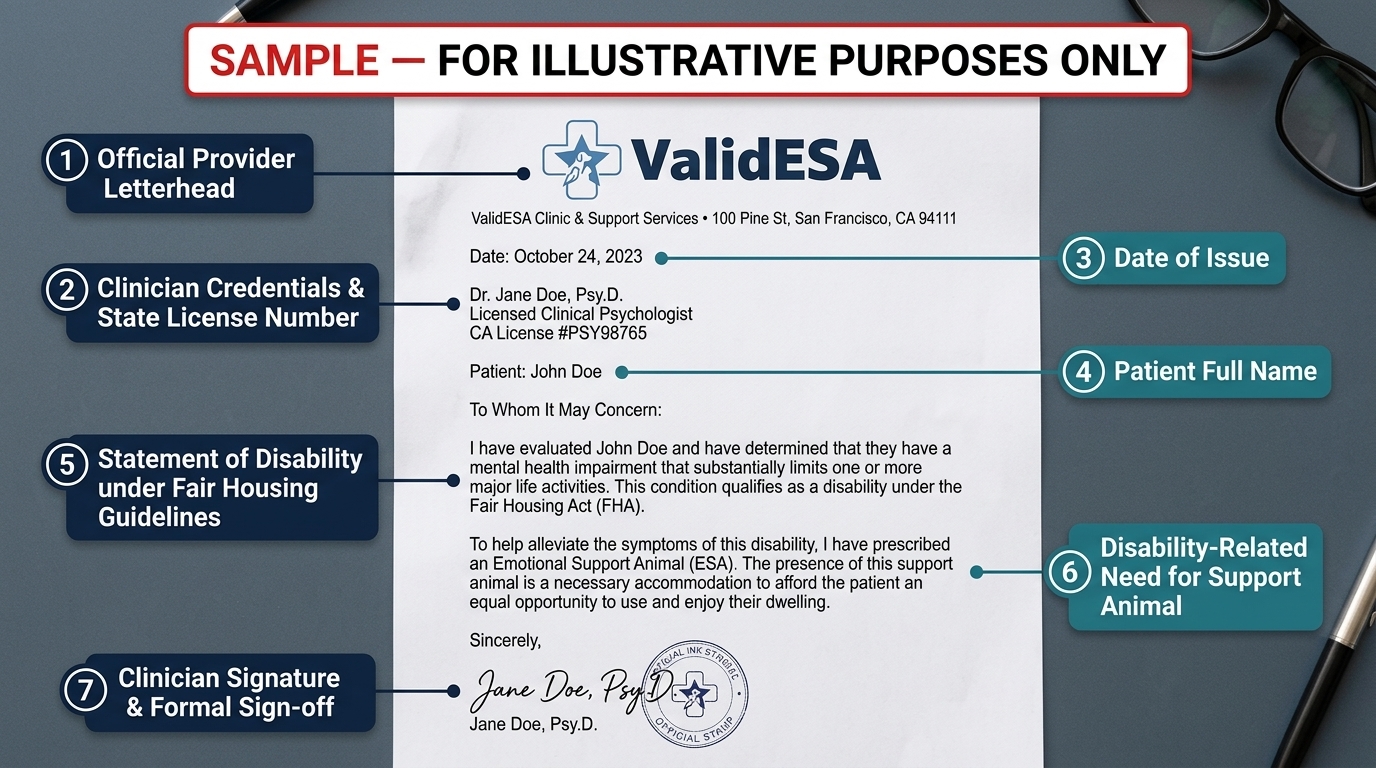
What an ESA letter includes (annotated sample)
A legitimate ESA letter usually contains:
- Clinician letterhead with practice name and contact details
- Clinician's name, license type, license number and issuing state (and, in California, the license's effective date)
- Date of issue
- Your name
- A statement that you have a disability under the applicable definition. A specific diagnosis is not required.
- A statement that the animal helps with a disability-related need
- The clinician's signature
Sample wording (illustrative)
"[Patient name] is under my care. [He/She/They] has a mental health-related disability that substantially limits one or more major life activities. An emotional support animal helps alleviate symptoms of this disability. I recommend [patient name] be allowed to live with [his/her/their] emotional support animal as a reasonable accommodation."
Wording must come from your clinician after an evaluation. See our ESA letter template page for what landlords expect.
Who qualifies for an ESA letter?
You may qualify if a clinician determines that you have a mental or emotional condition that substantially limits a major life activity and that an animal provides support for it. The Fair Housing Act defines handicap this way at 42 U.S.C. § 3602(h).
Conditions clinicians commonly consider include depression, anxiety disorders, post-traumatic stress disorder (PTSD), panic disorder and other conditions recognized in the DSM-5-TR. A diagnosis alone isn't enough. The condition must significantly affect your daily functioning, and the animal must help.
Who can write an ESA letter?
Typically a licensed mental health professional (LMHP), such as a:
- Psychologist
- Psychiatrist
- Licensed clinical social worker (LCSW)
- Licensed professional counselor (LPC/LPCC)
- Licensed marriage and family therapist (LMFT)
Physicians, nurse practitioners and physician assistants may also write disability documentation, depending on state scope-of-practice rules. In most states, the clinician must be licensed in the state where you live. California's AB 468 adds a 30-day client-relationship requirement for emotional support dog letters. See who can write an ESA letter.
What an ESA letter does and doesn't do
Setting | Does an ESA letter help? | Law |
|---|---|---|
Rental housing | Yes. It supports a reasonable-accommodation request. Strength now varies by state. | Fair Housing Act; state fair housing laws |
College dorms | Often. Schools assess requests under the FHA and Section 504. | FHA; Section 504 |
Airplanes | No. Airlines may treat ESAs as pets. | DOT Air Carrier Access Act rule, effective Jan. 11, 2021 |
Stores, restaurants, public places | No. ESAs aren't service animals under the ADA. | 28 C.F.R. § 36.104 |
Workplace | Case-by-case only, as a possible employment accommodation | ADA Title I (EEOC) |
Hotels | No general right | ADA public accommodations rules |
The 2026 HUD change: what it means for your letter
HUD withdrew its 2020 assistance-animal notice (FHEO-2020-01) effective September 17, 2025. Its May 22, 2026 memorandum reconfirmed the withdrawal. HUD will now find reasonable cause on a federal complaint only when an animal is individually trained to perform disability-related tasks. Untrained ESAs are no longer "presumptively reasonable" in HUD's enforcement.
What that means for you:
- The Fair Housing Act itself didn't change, and you can still bring a private lawsuit within two years.
- State laws still protect ESAs in many places. California's Civil Rights Department confirmed in July 2026 that FEHA continues to cover untrained assistance animals.
- A clear, verifiable letter matters more now, because landlords have more room to question weak documentation.
Read our Fair Housing Act guide for details.
ESA letter vs. ESA certificate vs. registration vs. prescription
ESA letter | ESA certificate | ESA registration | Prescription | |
|---|---|---|---|---|
Issued by | Licensed clinician after an evaluation | Websites, often instantly | Private websites | Prescribers, for medication |
Legal weight | Supports an accommodation request | None on its own | None. No official registry exists. | Not used for ESAs |
Includes license details | Yes | Usually not | No | n/a |
Landlord can verify | Yes | No | No | n/a |
People sometimes call an ESA letter an "ESA prescription" or "doctor's note." Those labels are informal. What matters is that a licensed professional evaluated you and signed the letter.
What is an ESA document? 'Emotional support pet letter' and other names explained
An "ESA document" is the ESA letter itself.
Yes. "Emotional support pet letter," "animal support letter," "ESA pet letter," "pet ESA letter," "ESA papers" and "ESA paperwork" all describe the same document. There is no official government "form for ESA." The letter is the paperwork. Some landlords and screening portals ask you to upload the letter or have your clinician fill in a verification form; that's different from a registry.
How to get an ESA letter in 5 steps
- Check your state's rules. For example, California requires a 30-day client relationship for emotional support dog letters.
- Talk to a licensed clinician: your current provider or a telehealth service matched to your state.
- Complete a genuine evaluation. A letter is issued only if the clinician determines you qualify.
- Check the letter for the seven elements above.
- Submit a short written request to your landlord with the letter and keep copies.
Full walkthrough: how to get an ESA letter.
ESA letters for different animals
Dogs and cats are the most common ESAs. Landlords generally accept them when documentation is reliable. In California, AB 468's extra rules (30-day relationship, license details) apply specifically to emotional support dog documentation.
Other common household animals, such as rabbits, birds, small rodents, fish and turtles, can be ESAs. Requests for unusual animals, such as reptiles requiring special habitats, farm animals or exotic species, face more scrutiny. Expect the landlord to ask how this specific animal relates to your disability-related need, and to consider health, safety and local animal-control laws.
More than one animal: each must serve a disability-related need, and your clinician should address each one.
How a telehealth ESA evaluation works
A legitimate online evaluation looks a lot like any first therapy appointment:
- Intake questions about your symptoms, how long you've had them and how they affect sleep, work, relationships and daily tasks
- History of any mental health treatment or diagnoses
- The animal's role: how your animal helps, such as calming during panic, structure and routine, or reducing isolation
- Clinical judgment: the clinician decides whether you meet the definition of disability and whether the animal helps with a related need
- Licensing: the clinician must be licensed where you're located, and must follow any state-specific rules such as California's 30-day relationship
If the clinician doesn't think an ESA letter is appropriate, a legitimate service won't issue one.
What happens after you give your landlord the letter
- The landlord reviews it. They may verify the clinician's license and confirm the letter is authentic.
- The interactive process. If something is unclear, the landlord may ask follow-up questions, but not for your diagnosis.
- A decision. Approval may come with ordinary conditions: following leash and noise rules, local licensing and vaccination, and responsibility for damage.
- Renewal. Some landlords ask for updated documentation at lease renewal.
Read more about ESA verification.
8 common myths about ESA letters
- "ESAs must be registered." False. There's no official ESA registry.
- "A certificate or ID card is enough." False. Only clinician documentation supports an accommodation request.
- "ESA letters let you bring your animal anywhere." False. ESAs have no ADA public-access rights.
- "Airlines must accept ESAs." False since January 11, 2021.
- "Any doctor anywhere can write one." Usually false. The clinician generally must be licensed in your state.
- "An ESA letter guarantees approval." False, especially after HUD's May 2026 change. Landlords can deny for lawful reasons.
- "ESAs need training." False for ESAs, though HUD's 2026 enforcement now favors trained animals. Trained animals that perform tasks may qualify as service animals.
- "Your letter must name your diagnosis." False. It needs to confirm a disability and a related need, not the diagnosis.
ESA letters for college students
College housing is covered by the Fair Housing Act and, at most colleges that receive federal funding, Section 504. Students usually submit ESA requests through the school's disability services office, which may have its own forms and deadlines. Some schools accept a letter from an outside clinician; others want a provider form completed. Start early, ideally before housing assignments are made.
Glossary of ESA letter terms
- Emotional support animal (ESA): an animal that provides support for a disability-related need without task training.
- Service animal: under the ADA, a dog (or in some cases a miniature horse) individually trained to do work or tasks for a person with a disability.
- Assistance animal: umbrella term in housing law for service animals and support animals.
- Reasonable accommodation: a change to rules or policies needed for equal housing opportunity.
- LMHP: licensed mental health professional.
- Interactive process: the good-faith dialogue between tenant and landlord about an accommodation.
ESA letter vs. psychiatric service dog letter
A psychiatric service dog (PSD) is individually trained to perform tasks related to a mental health disability, such as interrupting panic attacks, providing deep pressure therapy on cue or waking a person from nightmares. That's different from an ESA, whose comfort comes from its presence.
ESA letter | Psychiatric service dog | |
|---|---|---|
Training required | No | Yes, task training |
Housing (HUD 2026 enforcement) | Not presumptively reasonable | Presumptively reasonable |
Public places (ADA) | No | Yes |
Airlines | No | Yes, with DOT forms |
Documentation | Clinician letter | ADA doesn't require documentation for public access; housing providers may ask about disability-related need when it isn't obvious |
If your dog already performs disability-related tasks, talk to your clinician about whether a PSD is a better fit. Don't call an animal a service animal unless it truly meets the ADA definition.
Can you get an ESA letter if you're already in treatment?
Yes, and it's often the easiest route. A clinician who already knows you can judge your need better than one meeting you for the first time. In California, an existing relationship of 30+ days already meets AB 468's requirement for dog letters. Ask at your next appointment.
What if a clinician says no?
A clinician may decide an ESA letter isn't appropriate, for example if symptoms don't substantially limit daily life, or another treatment is more suitable. That's a clinical judgment, not a rejection of you. Ask what they recommend instead. Avoid "shopping" for a site that issues letters automatically, since that kind of documentation is the type landlords can reject.
Questions to ask before choosing an ESA letter provider
- Is the clinician licensed in my state, and can I see the license number before paying?
- Will I actually speak with or be assessed by the clinician?
- Does the service follow state rules like California's 30-day requirement?
- What happens if I don't qualify?
- Will the clinician respond to landlord verification requests?
- Is renewal available, and what does it cost?
How to tell your landlord about your ESA
Keep the request short and factual. You don't need to explain your diagnosis.
Sample request
Dear [Landlord], I'm requesting a reasonable accommodation to live with my emotional support animal, [name, species], at [address]. I've attached a letter from my licensed clinician. Please let me know if you need anything else to review this request.
Thank you, [Name]
Send it by email so you have a dated record, and keep a copy of the letter you attached. If the landlord uses an online portal, upload the letter there as well, and save the confirmation.
Does an ESA letter cover roommates, guests or a new apartment?
- Roommates: the letter covers your need. A roommate's animal needs its own documentation.
- Visiting someone else's home: the letter supports accommodations where you live, not places you visit.
- Moving: your letter can be used at a new rental if it's still current and your clinician remains licensed in your new state. If you move to a different state, you'll usually need a clinician licensed there.
Is an ESA letter private?
Your clinician keeps your clinical records confidential. The letter itself shares only what's needed: that you have a disability and a related need for the animal. Give it only to the housing provider reviewing your request, and ask them to store it separately from your general tenant file.
How long an ESA letter lasts and renewal
No federal law sets an expiration date for ESA letters. In practice, many landlords and screening portals ask for a letter dated within the last 12 months, especially at lease renewal. Many clinicians re-evaluate yearly, which also confirms the need is ongoing. See ESA letter renewal.
See if an emotional support animal is right for you. Start your assessment.
Conclusion: what is an ESA letter, in one sentence
What is an ESA letter? It's verifiable documentation from a licensed clinician that supports a housing accommodation request for your emotional support animal. It's not a certificate, registration or public-access pass, and in 2026 its strength depends on your state's law.
Related reading
ESA verification: how landlords check a letter
Free ESA certification and registries explained (when live)
How to get a letter for an emotional support dog (when live)
Emotional support stuffed animals (when live)
Frequently asked questions
What is an ESA letter and what does it do?
It's a letter from a licensed clinician confirming you have a mental or emotional disability and that an animal helps with a related need. It supports a request for a housing accommodation, such as an exception to a no-pets policy.
Who qualifies for an emotional support animal letter?
People whose mental or emotional condition substantially limits a major life activity, and for whom an animal provides related support, as determined by a licensed clinician. A diagnosis alone isn't enough.
What is the difference between an ESA letter, an ESA certificate and a prescription?
An ESA letter is clinician-signed documentation after an evaluation. Certificates and registrations are website products with no legal weight. 'Prescription' is an informal term; ESAs aren't prescribed like medication.
Is an ESA letter the same as a doctor's note?
Similar in idea, but more specific. It must come from a licensed professional, typically a mental health professional, and state the disability-related need for the animal, with license details a landlord can verify.
What rights does an ESA letter give me?
Mainly the ability to request a housing accommodation. After HUD's May 2026 change, the strength of that request depends largely on state law. It gives no public-access, airline or hotel rights.
What is an ESA document?
An ESA document is the ESA letter: a signed letter from a licensed clinician confirming a disability and a disability-related need for the animal. There's no official government ESA form or registration.
Sources
- Fair Housing Act, 42 U.S.C. § 3602(h) (definition of handicap) and § 3604(f)(3)(B)
- HUD FHEO-2020-01 (Jan. 28, 2020), withdrawn effective September 17, 2025; Holland & Knight summary (June 2026): hklaw.com
- California Civil Rights Department, ESA Legal Alert (July 20, 2026): calcivilrights.ca.gov
- ADA service animal definition, 28 C.F.R. §§ 35.104, 36.104; ADA.gov service animal guidance
- U.S. DOT, Traveling by Air with Service Animals final rule (Dec. 2020; effective Jan. 11, 2021): transportation.gov
- California AB 468 (2021); Health & Safety Code § 122318; Board of Behavioral Sciences AB 468 FAQ: bbs.ca.gov
This article is for general information and is not legal or medical advice. Laws and agency enforcement policies change; check the cited sources or speak with a qualified attorney or licensed clinician about your situation.