
Pet Damage & Renters Insurance: Tenant and Landlord Guide (Can Landlords Require Pet Insurance?)
By the ValidESA Editorial Team · Reviewed by Dr Anita Sanders · Last updated:
Quick answer (AI snippet)
Tenants are responsible for damage their pets cause to a rental. Standard tenant insurance usually doesn't cover pet damage to the unit, so the security deposit, and the tenant beyond that, typically pays. Some insurers sell pet-damage endorsements. Many landlords can require renters insurance with liability coverage, depending on state law.
Key takeaways
- The tenant is responsible for pet damage beyond normal wear and tear.
- Standard renters (tenant) insurance usually excludes damage your pet does to the rental unit and your own belongings. It covers liability to others.
- Some insurers offer pet-damage endorsements; ask before you buy.
- Many landlords may require renters insurance with liability coverage in the lease, subject to state law.
- For assistance animals, extra insurance conditions are restricted in states that protect ESAs; federal enforcement narrowed in 2026.
Tenant insurance pet damage: who is responsible?
Before looking at tenant insurance pet damage coverage, start with responsibility.
The tenant is responsible for damage their pet causes beyond normal wear and tear. That's true for pets and for assistance animals; an approved ESA doesn't excuse damage. How it gets paid:
- Security deposit or pet deposit. The landlord deducts documented damage at move-out, within state deposit rules.
- The tenant directly, if damage exceeds the deposit.
- Insurance, only if the policy includes pet-damage coverage, which is uncommon.
- Landlord's own insurance, as a last resort for major losses, though insurers may then pursue the tenant.
Who pays if a pet damages the apartment? Usually the tenant, through the deposit and then directly.
What tenant insurance covers (and what the deposit covers)
Type of damage or loss | Standard tenant insurance | Security / pet deposit |
|---|---|---|
Your dog chews the rental's door frames | Usually not covered (property in your care) | Yes, deducted |
Your cat stains the carpet | Usually not covered | Yes, deducted |
Your dog bites a guest | Usually covered (liability), unless your dog or breed is excluded | No |
Your dog damages a neighbor's car | Usually covered (property damage liability) | No |
Your pet damages your own sofa | Not covered | No |
Fire caused by your pet knocking over a candle | Often covered as a fire loss to your belongings; damage to the building may fall under liability (check policy) | Possibly |
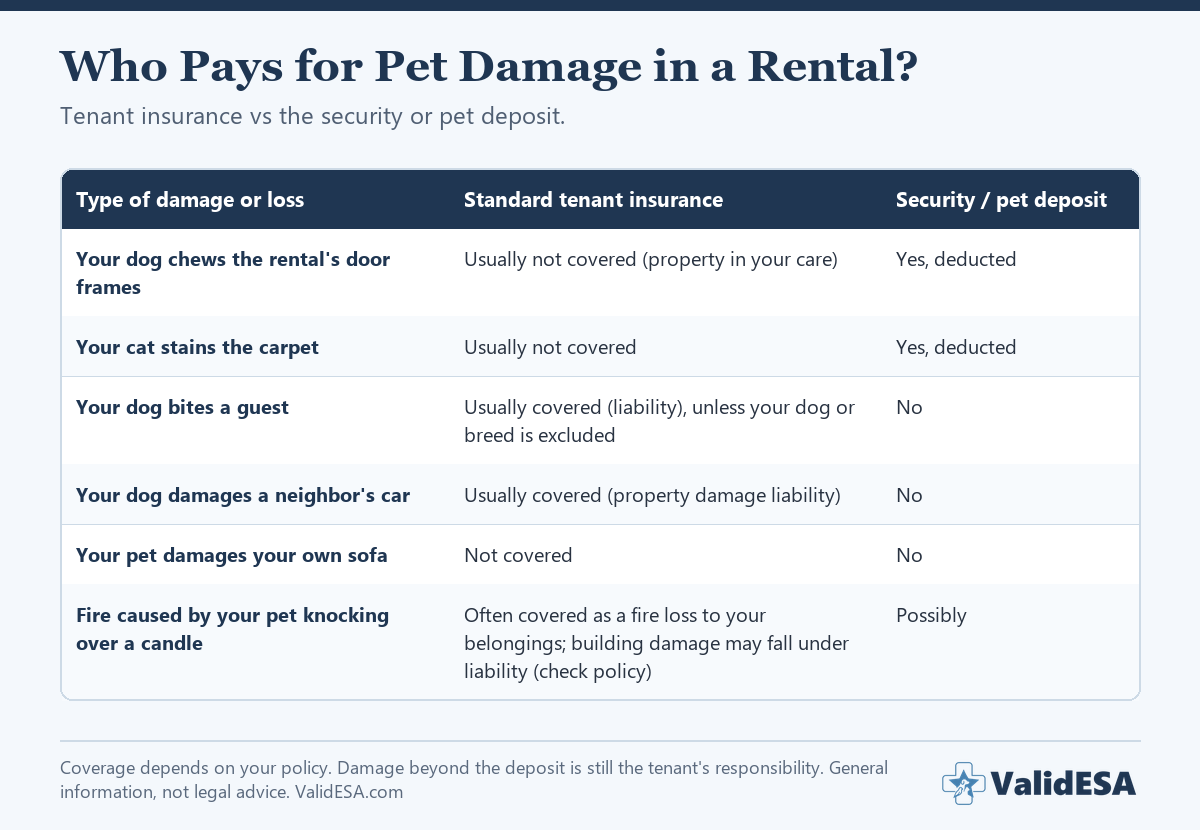
Does renters insurance cover pet damage? Generally no for damage to the unit or your own things. Yes, usually, for liability to other people. Renters insurance with pet damage coverage exists through endorsements from some insurers. Ask an agent. See renters insurance with pet coverage.
Can a landlord require pet insurance or renters insurance?
Can a landlord require pet insurance? In many states, landlords can make renters insurance, often with a minimum liability limit, a lease condition, and some pet-friendly landlords require pet liability coverage specifically. Rules vary:
- Some states and cities limit what landlords can require or how much they can charge for related programs.
- Requirements must apply equally and be in the written lease.
- Landlords generally can't require you to buy from a specific insurer, though rules vary.
Check your state's landlord-tenant law or attorney general's tenant guide before signing.
For landlords: insurance and lease clauses for pet-friendly rentals
Pet insurance for rental property usually means a few layers:
- Landlord (dwelling fire) policy covering the building; check for animal liability exclusions.
- Landlord liability coverage for injuries on the property.
- Tenant renters insurance requirement with a minimum liability limit (e.g., $100,000–$300,000) and the landlord as "interested party."
- Pet-damage protection products, such as security-deposit alternatives or damage waivers, where legal in your state.
Lease clause checklist:
- Pet types, number and size limits (with an assistance-animal exception)
- Pet deposit/fee/rent amounts within state caps (see pet fee vs pet deposit)
- Tenant's duty to pay for pet damage
- Renters insurance requirement and proof of coverage
- Waste, noise, leash and common-area rules
- Move-in/move-out inspection process with photos
ESA and service animals: what landlords can't require
Under HUD's former guidance (FHEO-2020-01), landlords were told not to require tenants with assistance animals to buy extra insurance or pay pet fees that weren't required of all tenants. HUD rescinded that guidance on September 17, 2025 and now finds reasonable cause only for task-trained animals, so federal enforcement for untrained ESAs is narrower. But:
- State laws such as California's FEHA still treat waiving pet-specific conditions as reasonable accommodations.
- A general renters insurance requirement that applies to every tenant can still apply to ESA owners.
- Tenants remain liable for actual damage.
Landlords should get fair-housing advice before applying pet-specific insurance rules to assistance animals. See our Fair Housing Act guide.
Real-world pet-damage scenarios
Scenario | Who likely pays |
|---|---|
Dog scratches hardwood floors through the finish | Tenant, via deposit; usually not covered by standard tenant insurance |
Cat urine soaks carpet padding | Tenant, via deposit and directly if it exceeds the deposit |
Dog bites a neighbor in the hallway | Tenant's renters liability coverage, if the dog isn't excluded |
Pet knocks over a space heater and causes a fire | Often tenant's renters insurance (fire to belongings; liability for building damage); landlord's policy may respond and pursue the tenant |
ESA chews blinds | Tenant, even though pet fees may be waived for an approved ESA |
Security deposit alternatives and damage waivers
Some properties offer deposit alternatives: monthly fees or surety bonds instead of a cash deposit. These are not insurance for you. They usually protect the landlord, and the provider may still bill you for damage. Read terms carefully, and check whether your state regulates these products.
Landlord tips: reducing pet-damage disputes
- Use a detailed move-in checklist with photos signed by both sides
- Do mid-lease inspections with proper notice
- Put pet rules and damage responsibility in writing
- Itemize deductions with photos and receipts at move-out
- Follow your state's deposit-return deadline (e.g., 21 days in California)
Questions to ask your insurer about pet damage
- Does my policy cover any damage my pet causes to the rental unit?
- Is a pet-damage endorsement available, and what does it cost?
- Is my pet's breed or species excluded from liability?
- Does liability apply if my pet injures someone off the property?
- How would a claim affect my renewal?
Pet damage timeline: what to do at each stage
- Before move-in: read pet clauses; buy renters insurance; ask about pet-damage endorsements; record move-in condition.
- During the lease: prevent damage, fix small issues promptly, report problems to the landlord early.
- Before move-out: clean thoroughly, repair minor damage where allowed, request a pre-move-out inspection if available.
- After move-out: provide a forwarding address; review the itemized statement; dispute improper deductions in writing, and in small claims court if needed.
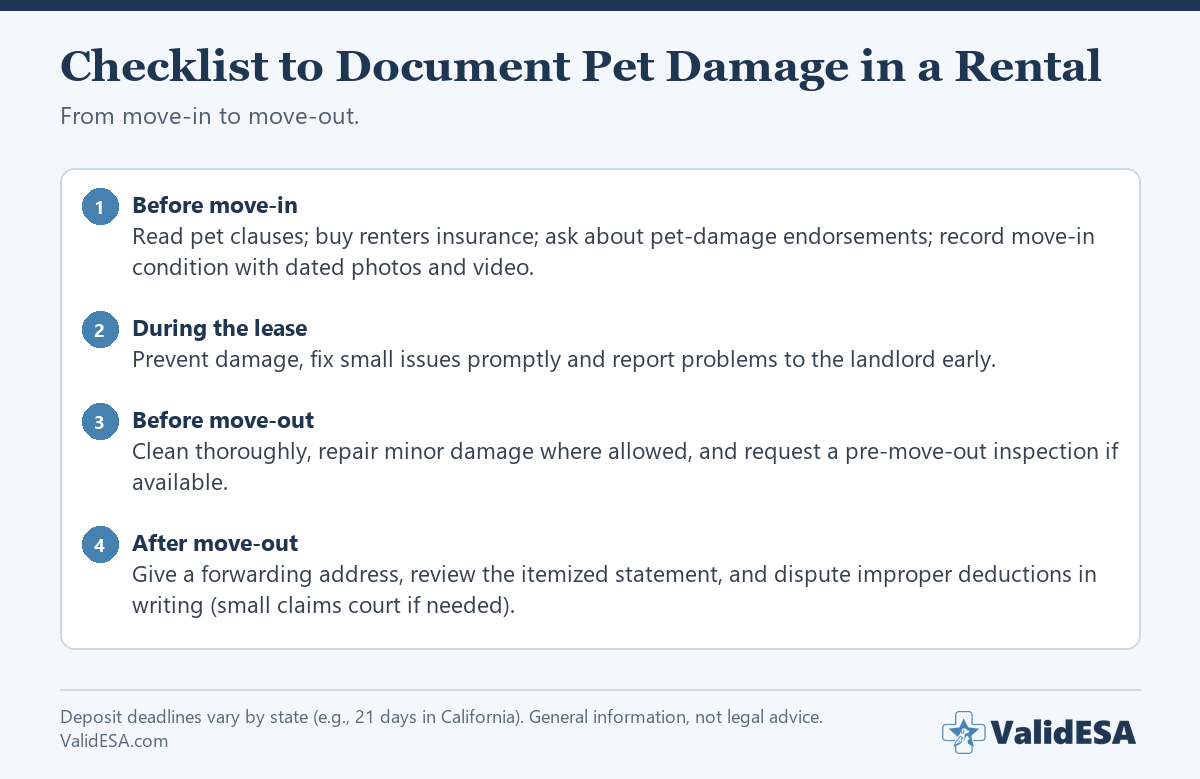
How tenants can protect themselves from pet-damage costs
- Document move-in condition with dated photos and video.
- Ask about a pet-damage endorsement on your renters policy.
- Prevent damage: scratching posts, crate training, rugs and furniture covers.
- Fix small issues before move-out if your lease allows.
- Request a pre-move-out inspection where your state provides one (California does, Civ. Code § 1950.5(f)).
- Know your deposit rights: itemized deductions and deadlines vary by state.
Normal wear and tear vs pet damage
Usually normal wear and tear | Usually pet damage |
|---|---|
Light carpet traffic wear | Urine stains and odor |
Minor scuffs | Chewed trim or doors |
Faded paint | Deep floor scratches through the finish |
Loose fixtures from use | Torn screens or blinds |
Conclusion: tenant insurance and pet damage
Tenant insurance pet damage coverage is limited: standard renters policies protect your liability to others, not damage your pet does to the unit. Your deposit, and you, usually pay for that. Ask about pet-damage endorsements, document move-in condition, and know your state's rules on what landlords can require.
Related reading
Renters insurance with pet coverage
Best renters insurance for pet owners
Frequently asked questions
Does renters insurance cover pet damage?
Usually not for damage your pet does to the rental unit or your own belongings. It typically covers your liability if your pet injures someone or damages another person's property. Some insurers sell pet-damage endorsements.
Can a landlord require pet insurance?
In many states, landlords can require renters insurance or pet liability coverage as a lease condition, applied consistently and in writing. Rules vary by state and city, and restrictions may apply to assistance animals.
Who pays if a pet damages the apartment?
The tenant, usually through deductions from the security or pet deposit, and directly for any amount above the deposit.
What insurance should landlords carry for pet-friendly rentals?
A landlord dwelling policy without broad animal exclusions, landlord liability coverage, and a lease requirement that tenants carry renters insurance with liability coverage.
Can my landlord keep my whole deposit for pet damage?
Only to the extent of documented damage beyond normal wear and tear, itemized according to your state's deposit law.
Does an ESA owner have to pay for pet damage?
Yes. Even when pet fees are waived for an approved ESA, the tenant remains responsible for actual damage the animal causes.
Can a landlord charge a pet-damage fee upfront?
Depending on state law, a landlord may charge a pet deposit or fee within any deposit cap. Rules for assistance animals differ and may bar pet charges under state law.
Should I buy a pet-damage endorsement?
If your pet is young, large or still in training, an endorsement may be worth pricing. Compare its cost against your deposit amount and likely damage.
Sources
- Insurance Information Institute, renters insurance guide: iii.org
- NAIC renters insurance consumer guide: content.naic.org
- HUD FHEO-2020-01 (rescinded September 17, 2025); Holland & Knight (June 2026): hklaw.com
- California Civil Rights Department ESA Legal Alert (July 20, 2026); California Civil Code § 1950.5
General information, not insurance or legal advice. Coverage depends on your policy and state; landlord requirements depend on state and local law, and different rules may apply to assistance animals.