
Psychiatric Service Dogs: What They Are, Who Qualifies & How to Get One
By the ValidESA Editorial Team · Reviewed by Dr Anita Sanders · Last updated:
Quick answer (AI snippet)
Psychiatric service dogs are dogs individually trained to perform tasks for a person with a mental health disability, such as interrupting panic attacks or giving deep pressure therapy. Under the ADA they are service animals with public-access rights. Getting one requires a qualifying disability and a dog trained to do specific tasks.
Key takeaways
- A psychiatric service dog (PSD) is a service dog trained to perform tasks related to a psychiatric disability.
- The training - not a letter, vest or registration - makes a dog a PSD.
- PSDs have ADA public access, Fair Housing Act protection and DOT air-travel rights.
- Depression, PTSD, anxiety, bipolar disorder and schizophrenia are examples of conditions that may qualify.
- "Psychiatric support dog" is a common misnomer - it usually means either a PSD or an ESA, which have very different rights.
What is a psychiatric service dog?
What is a psychiatric service dog? It is a dog individually trained to do work or perform tasks for a person whose disability is psychiatric. The ADA defines a service animal by function, not by diagnosis: 28 C.F.R. § 36.104 covers dogs trained for tasks related to "physical, sensory, psychiatric, intellectual, or other mental" disabilities. Psychiatric service dogs are therefore service dogs in every legal sense - they simply serve mental health needs instead of, say, vision loss.
The key word is trained. Comfort a dog gives just by being there does not count as a task under the ADA. A dog that is trained to recognize the start of a panic attack and respond on cue does.
Psychiatric support dog, PSD dogs and ESAs: getting the words right
People search for a "psychiatric support dog" or "psychiatric support animal" more than almost any other term in this area, but neither phrase appears in federal law. Usually the person means one of two very different things:
Psychiatric service dog (PSD) | Emotional support animal (ESA) | |
|---|---|---|
Training | Individually trained for disability-related tasks | No task training required |
Species | Dogs (ADA) | Any common domestic animal |
Public places (ADA) | Yes | No |
Housing (FHA) | Yes | Possible accommodation; HUD enforcement narrowed in 2026 |
Flights (DOT) | Yes, with DOT forms | No - airlines may treat as pets |
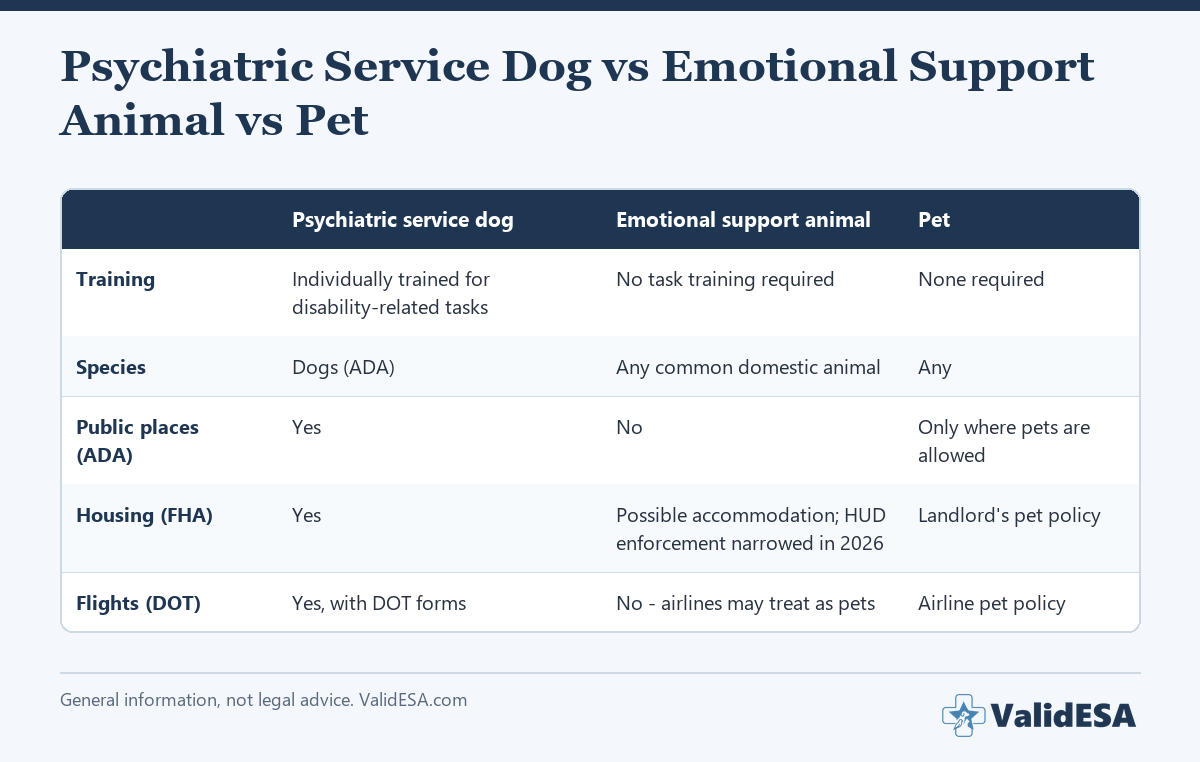
PSD dogs are a subset of service dogs. If your animal provides comfort but has no trained tasks, it is an ESA. For the full side-by-side, see psychiatric service dog vs ESA.
Mental health conditions that may qualify
A PSD requires a disability: a mental health condition that substantially limits one or more major life activities. Examples where service dogs for mental illness are commonly used include:
- Post-traumatic stress disorder (PTSD) - see service dog for PTSD
- Generalized anxiety and panic disorder - see service dog for anxiety
- Major depressive disorder
- Bipolar disorder
- Obsessive-compulsive disorder
- Schizophrenia and other psychotic disorders
- Autism spectrum disorder (when psychiatric tasks are involved)
Having a diagnosis is not enough by itself; the question is whether trained tasks mitigate your disability. See our overview of qualifying mental health conditions.
Service dogs for schizophrenia
Service dogs for schizophrenia are less common but well documented. Handlers describe dogs trained to interrupt repetitive behaviors, wake them during disturbing episodes, prompt medication routines or help reality-test by responding (or not) to a perceived stimulus. Close work with a treating psychiatrist matters here, because symptoms and safety needs vary widely.
Tasks psychiatric service dogs perform
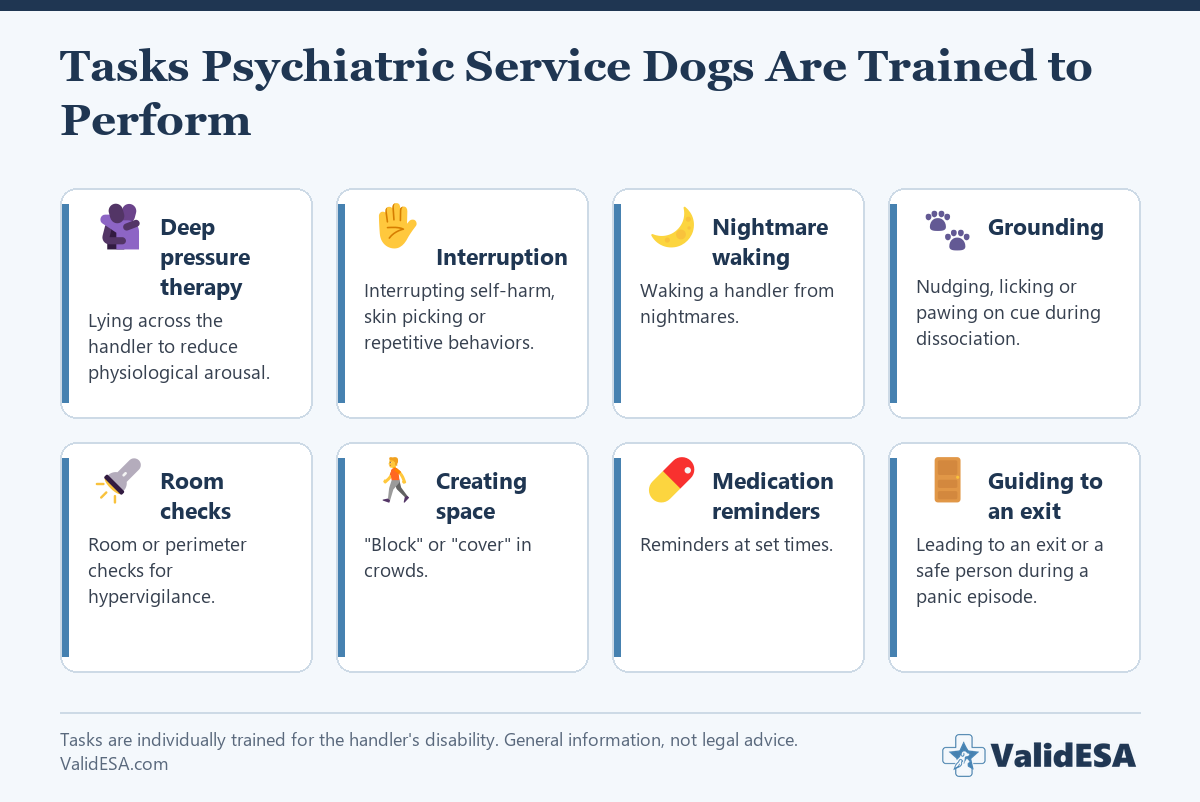
A service dog mental health task must be a specific, trained behavior linked to the disability. Common examples:
- Deep pressure therapy - lying across the handler to reduce physiological arousal
- Interrupting self-harm, skin picking or repetitive behaviors
- Waking a handler from nightmares
- Grounding during dissociation (nudging, licking, pawing on cue)
- Room or perimeter checks for hypervigilance
- Creating space in crowds ("block" or "cover")
- Medication reminders at set times
- Leading the handler to an exit or a safe person during a panic episode
What does not count: general companionship, calming presence, or "protection" behavior. A mental health service dog's value is in what it is trained to do.
Your rights with a psychiatric service dog
Public places (ADA)
Businesses, restaurants, stores and hotels must admit psychiatric service dogs. When the task isn't obvious, staff may ask only two questions: is the dog required because of a disability, and what task has it been trained to perform? They may not ask about your diagnosis, demand documentation or require a vest (28 C.F.R. § 36.302(c)(6)). The dog must be housebroken and under control.
Housing (Fair Housing Act)
A PSD is an assistance animal under the Fair Housing Act. Since HUD's May 22, 2026 policy change, requests for individually trained animals remain "presumptively reasonable," so PSD handlers are in a stronger federal position than ESA owners. A landlord may ask for reliable documentation of a disability-related need if it isn't obvious.
Air travel (DOT)
Under the DOT rule effective January 11, 2021, airlines must accept trained service dogs, including PSDs, and may require the DOT Service Animal Air Transportation Form. Details in flying with a psychiatric service dog.
Work
Employment falls under ADA Title I, which works differently: a service dog at work is a reasonable accommodation request handled case by case with your employer.
How to get a psychiatric service dog: 5 steps
- Talk to a licensed clinician about whether your condition is a disability and whether trained tasks would help. Check if you qualify.
- Choose a route: a program-trained dog from a reputable organization, a professional trainer, or owner-training.
- Select a suitable dog - temperament, health and age matter more than breed.
- Train the tasks and public-access behavior. Owner-training is legal under the ADA; see train your own psychiatric service dog.
- Get documentation where it helps: a PSD letter supports housing requests and DOT forms, but it does not replace training.
Find out if a PSD letter is right for you Check if you qualify
Cost and timeline
Program-trained psychiatric service dogs commonly cost $15,000-$30,000 or more and can involve waitlists of a year or longer, although some nonprofits place dogs with veterans at low or no cost. Owner-training is cheaper (trainer fees, equipment, vet care) but usually takes one to two years to reach reliable public-access standards. (GoodRx, November 17, 2022; Unity Service Dogs, accessed November 3, 2026.)
Service dogs for mentally ill adults: who they help most
Service dogs for mentally ill adults - the phrase many people search, although "people with mental health disabilities" is the better term - help most when symptoms are episodic and predictable enough for a dog to learn cues. A dog can learn to notice pacing, rapid breathing, skin picking or a change in voice, and respond the same way every time. That consistency is what turns a pet into a working dog.
Service animals for mental illness are also used by people whose symptoms make leaving home hard. A dog trained to create space, guide to an exit or provide deep pressure on cue can make transit, shopping or appointments possible again. For others, the main benefit is at night: waking a handler from nightmares or turning on lights.
What a psychiatric service dog is not
- Not a therapy dog. Therapy dogs visit hospitals or schools to comfort many people and have no public-access rights.
- Not an emotional support animal. ESAs help by being present and have no task training or ADA access.
- Not a protection dog. Guarding or aggressive behavior is a reason a business can exclude a dog.
- Not a breed or a certificate. Any breed can be trained; no certificate creates a PSD.
Choosing a dog with the right temperament
Most PSD candidates that wash out do so because of temperament, not intelligence. Look for a dog that recovers quickly from surprises, is neutral to other dogs, enjoys working with people and tolerates handling. Labrador and golden retrievers, standard poodles and many mixed breeds are common choices, but individual temperament matters more than breed. A professional trainer's evaluation before you commit can save months.
Size and health
Deep pressure therapy usually needs a medium or large dog; tasks like medication reminders work with any size. Ask a vet to screen for hip, elbow and eye problems in breeds prone to them, since a working dog needs to stay comfortable for years.
Training standards and public-access readiness
The ADA sets no specific training curriculum, but organizations such as Assistance Dogs International publish standards many trainers follow. A common benchmark is a public-access test: the dog stays calm and under control around food, crowds, noises, other dogs and confined spaces, and performs its tasks on cue. Many trainers suggest around 120 hours of training over six months or more, with at least 30 hours in public settings, as a minimum.
Skill area | Examples |
|---|---|
Foundation obedience | Sit, down, stay, recall, loose-leash walking |
Public manners | Settle under a table, ignore food and people, no sniffing displays |
Tasks | 2-3 disability-related tasks, reliable in different places |
Generalization | Same behavior at home, in stores, on transit |
Documentation: what helps and what doesn't
You don't need any document to enter a store with a psychiatric service dog. Documentation can still help in two places. For housing, a landlord may ask for reliable information about a disability-related need if it isn't obvious. For flights, airlines may require the DOT Service Animal Air Transportation Form. A PSD letter from a licensed clinician supports both, while registrations, ID cards and vests do not create any rights.
Living and working with a PSD day to day
- Plan for the dog's needs: water, relief breaks and rest during long days.
- Keep vaccination and license records handy for housing and travel.
- Expect occasional access challenges; a calm explanation of the two ADA questions usually resolves them.
- Keep training up - skills fade without practice.
- Plan for retirement, usually around 8-10 years, and what comes next.
Psychiatric service dogs and state law
Federal law sets the floor; states can add protections or penalties. Many states give service dogs in training public access when they are with a trainer, and many penalize misrepresenting a pet as a service dog. Rules differ, so check your state before relying on in-training access. ValidESA's state PSD letter pages summarize local rules.
When a business can ask a PSD to leave
- The dog is out of control and the handler doesn't take effective action, such as stopping repeated barking or jumping.
- The dog is not housebroken.
- The dog poses a direct threat in that situation.
Even then, the business must offer its goods or services to the person without the dog. It cannot exclude a well-behaved PSD because other customers are allergic or afraid.
A short history of psychiatric service dogs
Guide dogs for blind people came first, followed by dogs for hearing and mobility needs. Dogs trained for psychiatric tasks became more common from the 1990s onward, especially for veterans with PTSD. The 2010 ADA regulations made it explicit that dogs trained for psychiatric disabilities are service animals, and the 2021 DOT rule confirmed their place in air travel, even as airlines stopped accepting ESAs.
Myths about PSD dogs
- "I need to register my PSD." No federal registry or certification exists.
- "A vest makes it official." Vests are optional and prove nothing.
- "Only certain breeds qualify." Any breed can be a PSD if trained and under control.
- "A letter makes my dog a PSD." Only task training does.
- "PSDs can go anywhere, no matter what." A business can exclude a dog that is out of control or not housebroken.
Conclusion: psychiatric service dogs in 2026
Psychiatric service dogs are trained service dogs for people with mental health disabilities. The training is what earns ADA public access, stronger housing protection and air-travel rights. If you think a PSD could help, start with a clinician's evaluation, choose a training route you can sustain, and use documentation to support - never replace - that training.
Frequently asked questions
What qualifies you for a psychiatric service dog?
A mental health condition that substantially limits a major life activity, plus a dog individually trained to perform tasks that mitigate it. A licensed clinician can assess the disability; training creates the service dog.
Is a psychiatric support dog the same as a psychiatric service dog?
"Psychiatric support dog" is not a legal term. If the dog is trained for disability-related tasks, it is a psychiatric service dog; if it provides comfort without trained tasks, it is an emotional support animal.
Are psychiatric service dogs covered by the ADA?
Yes. The ADA covers dogs trained to perform tasks related to psychiatric disabilities, so PSDs have the same public-access rights as other service dogs.
Can I train my own psychiatric service dog?
Yes. The ADA does not require professional training. The dog must be trained to perform disability-related tasks and behave appropriately in public.
Do psychiatric service dogs need a letter?
Not for public places - businesses cannot require documentation. A letter can help with housing requests and supports DOT forms for flights, but it does not make a dog a service dog.
How much do psychiatric service dogs cost?
Program-trained dogs commonly cost $15,000-$30,000 or more; owner-training costs less but takes time. Some nonprofits place dogs with veterans at low or no cost.
Are service dogs for schizophrenia common?
Less common than for PTSD or anxiety, but well documented. Tasks can include interrupting repetitive behaviors, waking the handler and prompting routines, planned with a treating psychiatrist.
What is the difference between a mental health service dog and a therapy dog?
A mental health service dog is trained to perform tasks for one person with a disability and has public-access rights. A therapy dog comforts many people in visits and has no such rights.
Do psychiatric service dogs have to wear a vest?
No. Vests and ID cards are optional under the ADA and prove nothing. Many handlers use them to reduce questions from the public.
Can a psychiatric service dog be any breed?
Yes. The ADA does not restrict breeds. What matters is that the dog is trained for disability-related tasks and stays under control in public.
Sources
- ADA Title III regulations, 28 C.F.R. §§ 36.104, 36.302(c); ADA.gov "Frequently Asked Questions about Service Animals and the ADA"
- U.S. DOT, "Traveling by Air with Service Animals" final rule, 14 C.F.R. Part 382 (effective Jan. 11, 2021); DOT Service Animal Air Transportation Form
- Fair Housing Act, 42 U.S.C. § 3604(f); HUD FHEO memo rescinding FHEO-2020-01 (May 22, 2026)
- ADA Title I / EEOC reasonable accommodation guidance: eeoc.gov
- National Institute of Mental Health condition pages: nimh.nih.gov
- Assistance Dogs International standards: assistancedogsinternational.org
This article is for general information and is not legal or medical advice. Laws and agency enforcement policies change; check the cited sources or speak with a qualified attorney or licensed clinician about your situation.
Related reading
- Psychiatric service dog vs ESA
- How to get a service dog for anxiety
- How to get a service dog for PTSD
- PSD letter