
PetScreening and ESA Documentation: How Screening Portals Handle Emotional Support Animals
By the ValidESA Editorial Team · Reviewed by Dr Anita Sanders · Last updated:
Quick answer (AI snippet)
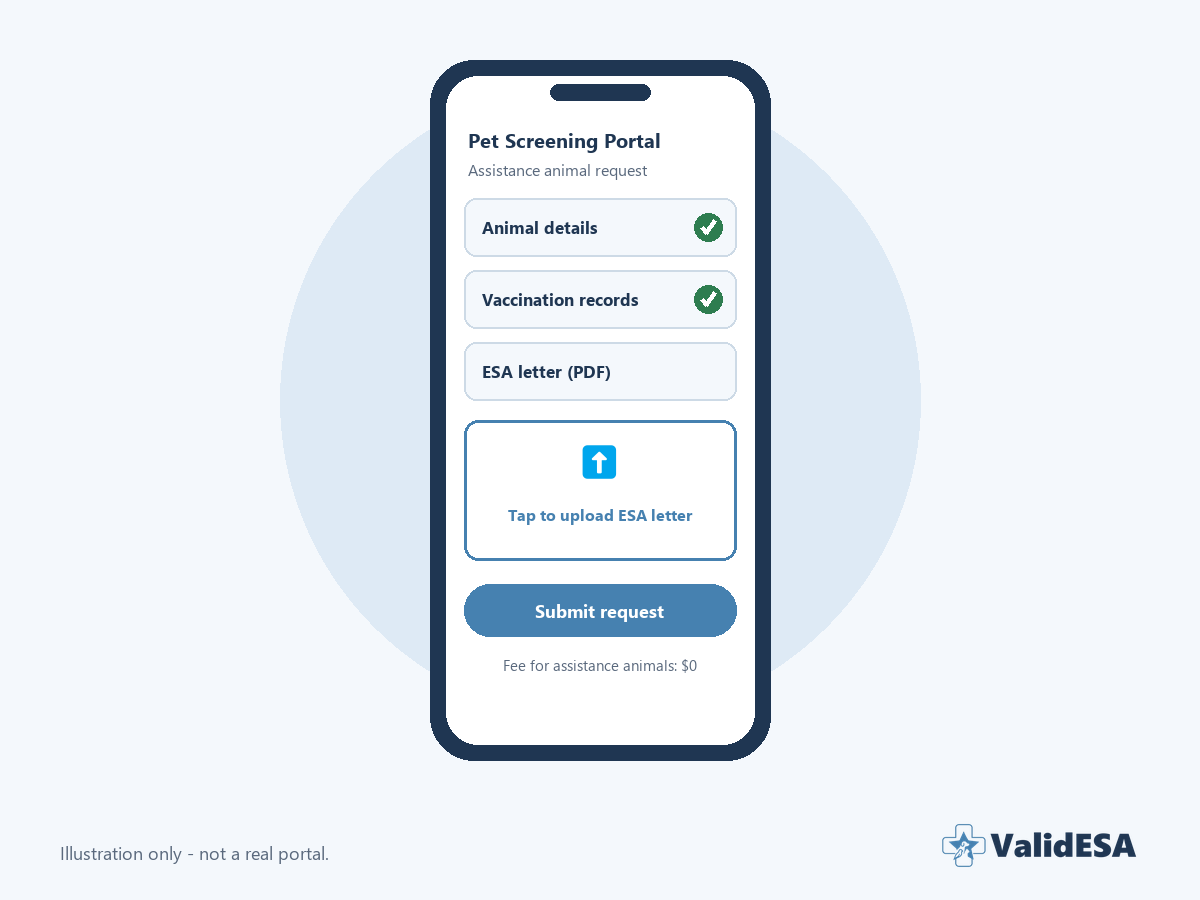
Many landlords use pet-screening portals like PetScreening to process ESA requests. You submit an assistance-animal accommodation request, not a pet profile, and upload your ESA letter. PetScreening says there's no charge to submit an assistance-animal request, and its team contacts your clinician to verify the letter. Never upload medical records or diagnoses.
Key takeaways
- An ESA request is a reasonable-accommodation request, not a pet application. Choose the assistance-animal path in the portal.
- PetScreening says submitting an assistance-animal accommodation request costs $0.
- Upload your ESA letter and basic animal details. Don't upload diagnoses or medical records.
- PetScreening says its team contacts your health care provider to confirm the letter is authentic, so make sure your clinician is reachable.
- If the portal treats your ESA like a pet, contact the property manager in writing.
PetScreening ESA requests: the short answer
Here's how a PetScreening ESA request works:
Do I need PetScreening for an ESA? If your landlord uses PetScreening or a similar portal, you'll usually submit your ESA request there. But you submit it as an assistance-animal accommodation request, not a pet profile. PetScreening's public materials say there's no charge ($0) to submit an assistance-animal request, and that its team verifies documentation with the health care provider.
What pet-screening portals do and why landlords use them
Property managers use portals like PetScreening to:
- Collect pet information, vaccination records and photos
- Assess household pets, for example with PetScreening's FIDO Score for pet profiles
- Process assistance-animal accommodation requests in a consistent way
- Verify documentation with third-party providers
- Keep records for fair-housing compliance
PetScreening reported in its own research that about 18% of reasonable-accommodation requests had insufficient documentation, unresponsive verifiers or fraud. That's why verifiable letters matter.
ESA vs pet: why your request is different
Do ESAs go through pet screening? They go through the portal, but not as pets. An ESA request asks for an exception to the pet policy as a disability accommodation. In portals, look for options like "Assistance Animal," "Reasonable Accommodation" or "Service/Support Animal" rather than "Add a Pet." Pet profiles may involve fees and scoring; assistance-animal requests generally don't.
What to upload, and what NOT to share
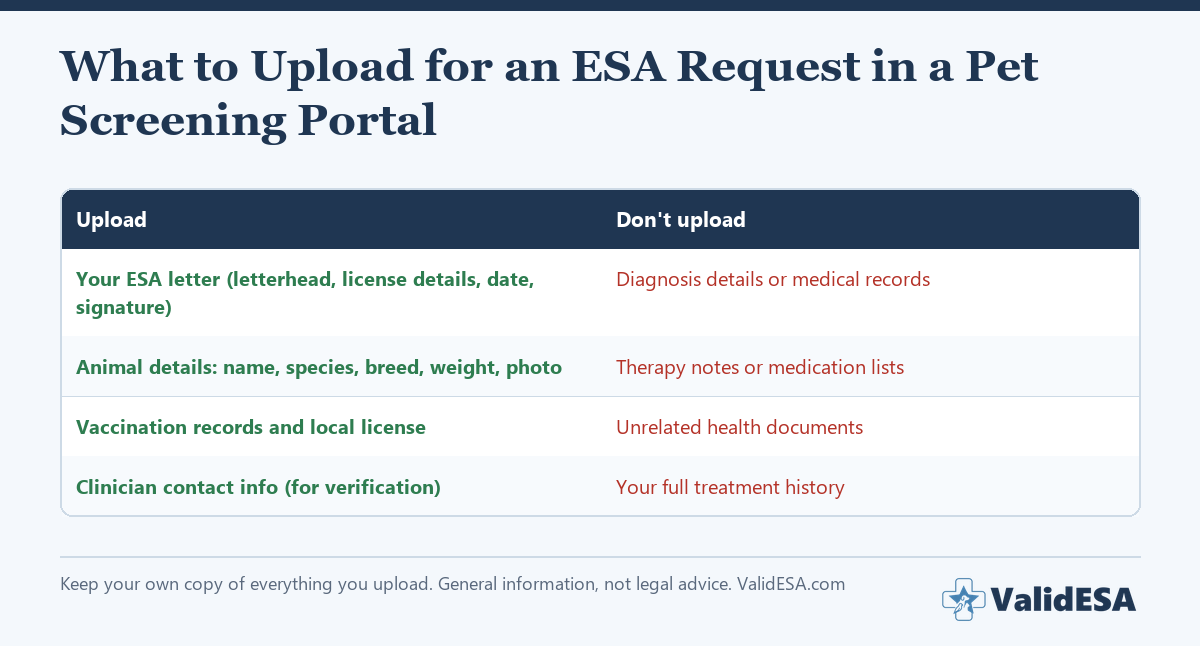
What documents do I upload for an ESA request?
Upload | Don't upload |
|---|---|
Your ESA letter (letterhead, license details, date, signature) | Diagnosis details or medical records |
Animal details: name, species, breed, weight, photo | Therapy notes or medication lists |
Vaccination records and local license | Unrelated health documents |
Clinician contact info (for verification) | Your full treatment history |
How do I keep my medical details private in a portal? Upload only the letter, which shouldn't include a diagnosis. PetScreening says it restricts access to health-related documents uploaded for accommodation requests. If a form asks for diagnosis information, leave it blank and contact the property manager.
Fees: what applies to assistance animals
Can a landlord charge a screening fee for an ESA?
- PetScreening: says there's no cost for an individual to submit an assistance-animal accommodation request. Fees for household pet profiles (reported at about $25–$30 per pet) don't apply to assistance animals.
- Federal law: HUD's former guidance (FHEO-2020-01) said assistance animals aren't pets and shouldn't be charged pet fees. HUD rescinded that guidance on May 22, 2026 and now pursues complaints only for trained animals, so federal enforcement on fees for untrained ESAs is uncertain.
- State law: many states still require fee waivers. California's Civil Rights Department, for example, lists waiving pet fees as a reasonable accommodation. Check your state, and see pet fee for rental.
Landlord view: processing ESA requests through a portal fairly
For property managers:
- Offer a clear assistance-animal path separate from pet applications.
- Don't charge application fees for accommodation requests where state law or your policy prohibits it.
- Request only what's needed: reliable documentation when disability or need isn't obvious, never diagnoses.
- Verify authenticity through the portal or license lookup. See ESA verification.
- Respond promptly. Unreasonable delay can count as a denial.
- Decide individually based on the specific animal, not breed or pet scores.
- Keep records confidential and separate from tenant files.
Troubleshooting: if the portal treats your ESA like a pet
- Charged a pet fee? Check whether you chose the pet path by mistake. Resubmit as an assistance animal and ask the property manager in writing to reverse the charge.
- Verification stuck? Ask your clinician to watch for the verification request. Unresponsive verifiers are a common delay.
- Asked for a diagnosis? Decline politely; offer your letter and clinician contact instead.
- Denied by "score"? Pet scores shouldn't decide assistance-animal requests. Ask for an individualized decision in writing.
- Still stuck? Contact a fair housing organization or your state civil-rights agency. See can landlords deny an ESA.
Sample message to your property manager
"I submitted a reasonable accommodation request for my emotional support animal, [name], through [portal] on [date]. My licensed clinician's letter is attached. Please process it as an assistance-animal request rather than a pet application, and let me know if you need anything else."
Other screening portals
PetScreening is one of several portals property managers use. Others work similarly. If yours is different, the same principles apply:
- Choose the assistance-animal or reasonable-accommodation path
- Upload your letter and animal details only
- Ask the property manager in writing if any fee is charged for an assistance animal
- Keep confirmation emails and screenshots
Checklist: submitting an ESA request through a portal
- Correct path selected (assistance animal, not pet)
- ESA letter uploaded (no diagnosis)
- Animal details and photo added
- Vaccination records uploaded
- Clinician notified to expect verification
- Confirmation saved
- Follow-up date set (7–10 days)
For property managers: common portal mistakes to avoid
- Routing assistance-animal requests into paid pet profiles
- Letting pet "scores" drive accommodation decisions
- Requesting diagnoses through custom questions
- Letting requests sit unanswered while waiting on verification. Communicate with the tenant.
Make verification easy
- Get a letter from a clinician licensed in your state
- Tell your clinician to expect a verification call or email
- Include your provider's verification reference, if any. ValidESA letters work with our landlord verification lookup.
- Submit early, at least two weeks before move-in
Need a verifiable ESA letter? Start your ESA assessment. Learn how to get an ESA letter or what an ESA letter for apartment needs.
Conclusion: PetScreening ESA requests done right
A PetScreening ESA request works best when you choose the assistance-animal path, upload a verifiable letter without medical details, and make sure your clinician responds to verification. Pet screening ESA rules on fees vary by state after HUD's 2026 change, so check yours.
Frequently asked questions
Do I need PetScreening for an ESA?
If your landlord uses PetScreening, you'll usually submit your ESA request there as an assistance-animal accommodation request, not a pet profile.
Do ESAs go through pet screening?
They go through the portal's assistance-animal process, which is separate from household pet screening and, per PetScreening, has no submission fee.
Can a landlord charge a screening fee for an ESA?
PetScreening says assistance-animal requests cost $0. Whether other fees can apply depends on state law; federal enforcement for untrained ESAs narrowed in May 2026.
What documents do I upload for an ESA request?
Your ESA letter, animal details, vaccination records and clinician contact information. Don't upload diagnoses or medical records.
How do I keep my medical details private in a portal?
Upload only your ESA letter, which shouldn't include a diagnosis, and decline requests for medical records. PetScreening says it restricts access to health documents.
How long does PetScreening ESA verification take?
It depends on how quickly your clinician responds to the verification request. Tell your clinician to expect it, and submit at least two weeks before move-in.
What if my clinician doesn't respond to PetScreening?
Unresponsive verifiers are a common delay. Follow up with your clinician, and ask your property manager whether another verification method is acceptable.
Does PetScreening decide whether my ESA is approved?
PetScreening reviews documentation and shares a recommendation, but the housing provider makes the accommodation decision.
Can a portal reject my ESA because of breed?
Breed alone shouldn't decide an assistance-animal request in states that protect ESAs. Decisions should rest on the specific animal's behavior. Ask the property manager for an individualized review.
Can I skip the portal and send my letter directly?
Ask your property manager. Many require the portal for consistency, but some accept direct submission. Get the answer in writing.
Will my landlord see my ESA letter in the portal?
Typically the property manager receives the verification outcome and may view your documentation. PetScreening says it restricts access to health-related documents. Upload only the letter, not medical records.
Sources
- PetScreening, Assistance Animals and FAQ pages (accessed November 2, 2026): petscreening.com
- PetScreening blog, '18% of reasonable accommodation requests have insufficient documentation, unresponsive verifiers or fraud': petscreening.com/blog
- HUD FHEO-2020-01 (rescinded May 22, 2026); Holland & Knight (June 2026): hklaw.com
- California Civil Rights Department ESA Legal Alert (July 20, 2026)
- Fair Housing Act, 42 U.S.C. § 3604(f)(3)(B)
ValidESA isn't affiliated with or endorsed by PetScreening or any screening portal; PetScreening is a trademark of its owner. Processes described are from public materials as of the date shown and may change. This article is general information, not legal advice.