
Pet Fee vs Pet Deposit vs Pet Rent: What's Normal, What's Legal (Incl. California)
By the ValidESA Editorial Team · Reviewed by Dr Anita Sanders · Last updated:
Quick answer (AI snippet)
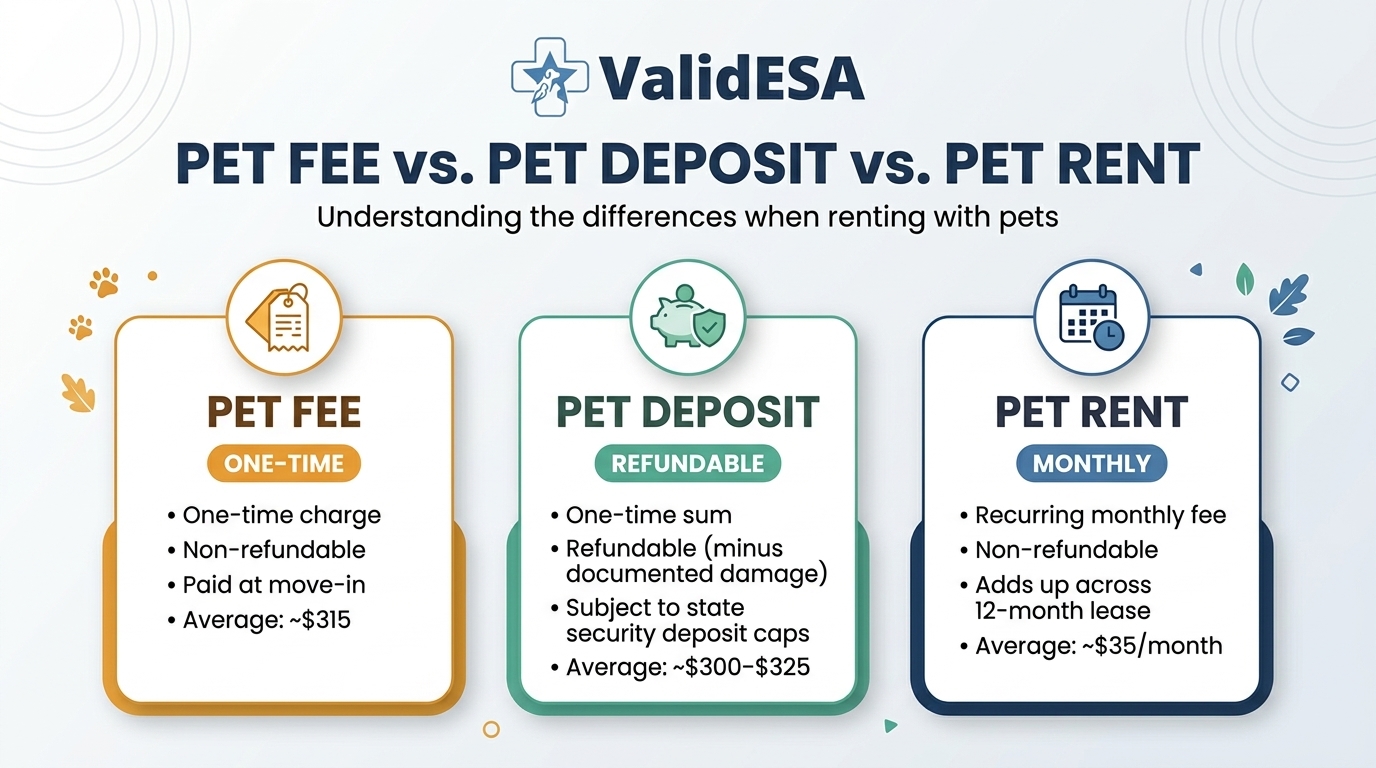
A pet fee is a one-time, usually non-refundable charge; a pet deposit is refundable money held against pet damage; pet rent is a monthly charge added to rent. In 2025, U.S. averages were about $35 a month for pet rent and roughly $300–$325 for a pet fee or deposit. State laws, like California's deposit cap, limit some charges.
Key takeaways
- Pet fee = one-time and usually non-refundable. Pet deposit = refundable, minus actual damage. Pet rent = recurring monthly charge.
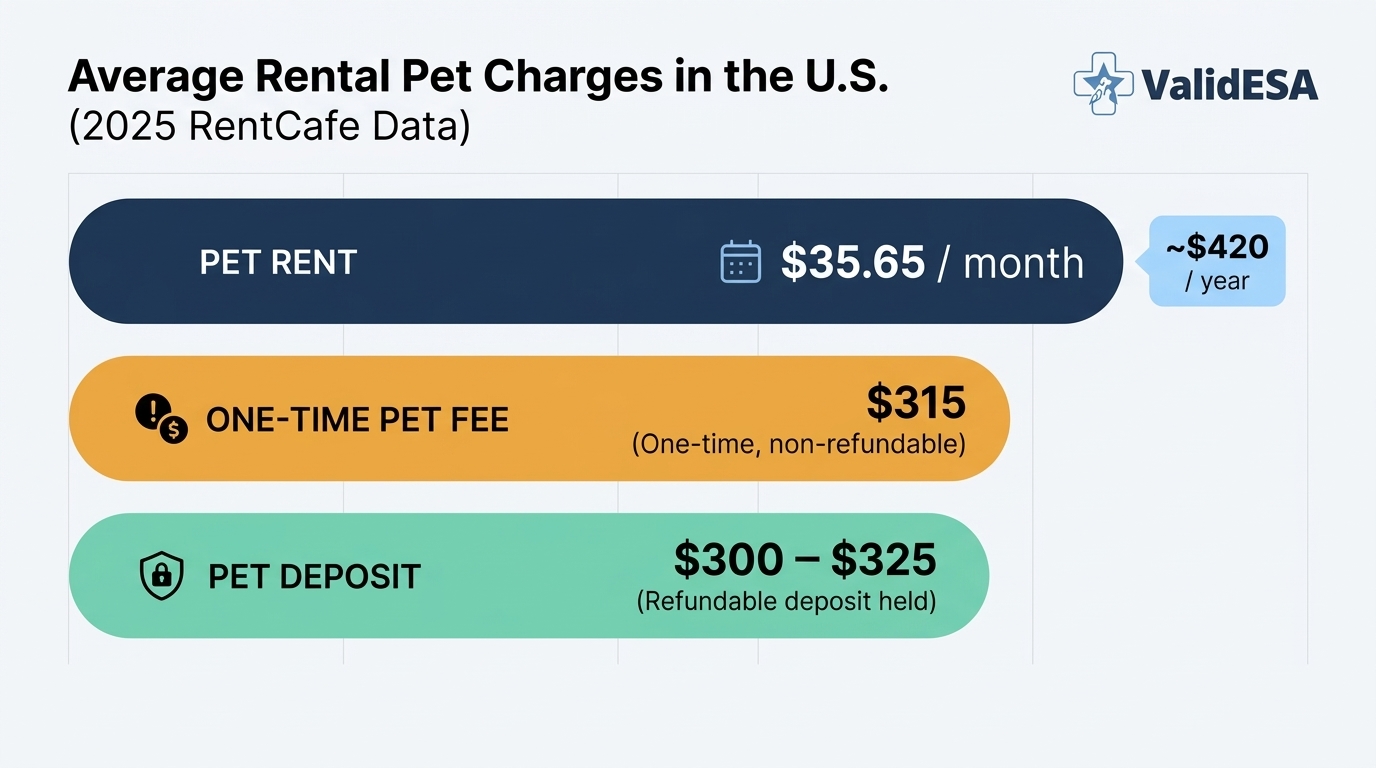
- 2025 averages: pet rent about $35.65/month; pet fee about $315; pet deposit about $300 (RentCafe).
- California caps total security deposits, including pet deposits in most readings, at one month's rent for most landlords since July 1, 2024 (AB 12).
- Monthly pet rent is legal in California. A 2024 bill (AB 2216) to limit pet charges didn't become law.
- ESA owners: California and other states still treat waiving pet fees as a reasonable accommodation, even after HUD's May 2026 federal change.
Pet fee for rental vs pet deposit vs pet rent: definitions
What is pet rent, and how is a pet fee for a rental different from a deposit? Pet fees for apartments come in three forms:
Pet fee | Pet deposit | Pet rent | |
|---|---|---|---|
What it is | One-time charge to allow a pet | Refundable sum held against pet damage | Monthly charge on top of rent |
Refundable? | Usually no | Yes, minus documented damage | No |
When paid | At move-in | At move-in | Every month |
Typical 2025 amount | ~$315 (RentCafe) | ~$300–$325 | ~$34–$36/month |
Counts toward deposit caps? | Depends on state; may be treated as a deposit if refundable | Usually yes | No (it's rent) |
Legal limits | State-specific | State deposit caps | Few states regulate directly |
How much is pet rent? Typical costs in 2025–2026
- Pet rent: RentCafe's 2025 data puts average monthly pet rent at $35.65, from $34.88 in small cities to $37.14 in large cities. The Pet-Inclusive Housing Initiative reports a $34 average.
- Pet fee (non-refundable): about $315 on average (RentCafe, 2025).
- Pet deposit (refundable): slightly over $300 (RentCafe), or $325 (Pet-Inclusive Housing Initiative).
How much for a pet deposit? The typical pet deposit for rental units, and the average pet deposit for rental homes nationally, is around $300–$325.
Over a 12-month lease, pet rent alone averages about $420, so a tenant paying a fee plus pet rent can spend around $700+ in year one for one pet.
Why do apartments charge pet rent?
Landlords cite extra wear and tear (flooring, carpets, landscaping), cleaning and turnover costs, administrative costs such as pet screening, and higher insurance exposure. Pet rent also gives a steady income stream. It isn't tied to actual damage the way a deposit is.
Is it legal? State rules and California deep-dive
Most states don't ban pet fees or pet rent. They regulate deposits: how much, how they're returned and what can be deducted. Rules vary widely, so check your state's landlord-tenant statute or attorney general's tenant guide.
California: pet deposits and the security-deposit cap
Pet rent in California and pet deposits follow these rules:
- AB 12 (Civil Code § 1950.5), effective July 1, 2024: most landlords may collect a total security deposit of no more than one month's rent, furnished or unfurnished. Pet deposits are generally treated as part of that total.
- Small-landlord exception: owners who are natural persons, family trusts or LLCs whose members are all natural persons, and who own no more than two residential rental properties with no more than four units in total, may collect up to two months' rent, except from service members.
- "$500 pet deposit California": there's no special $500 rule. A landlord can ask for a pet deposit as long as the total deposit stays within the cap.
- Is pet rent legal in California? Yes. No state law currently bans monthly pet rent. AB 2216 (2024), which would have limited pet charges, did not become law.
- Refunds: the landlord must return the deposit, with an itemized statement of deductions, within 21 days after the tenant moves out (Civ. Code § 1950.5(g)).
California pet rent isn't capped by statute, but local rent-control ordinances may affect total rent increases. Check your city.
See our full California ESA laws guide.
How much should I charge for pet rent? Advice for landlords
- Keep charges in line with the market: about $35/month pet rent or a one-time fee near $300 is average nationally.
- Prefer a refundable deposit if you want to encourage care. Make sure the total deposit fits your state's cap.
- Put every pet charge in the lease, including whether it's refundable.
- Don't charge pet fees for service animals. For ESAs, follow your state law. California treats waiving pet fees as a reasonable accommodation.
- Consider requiring renters insurance with liability coverage. See renters insurance with pet coverage.
For tenants: ways to lower pet costs
- Build a pet resume: vaccinations, spay/neuter, training classes, photos.
- Offer references from past landlords.
- Show proof of renters insurance with pet liability.
- Negotiate, for example a refundable deposit instead of monthly pet rent.
- Ask about discounts for older, smaller or trained pets.
- Search for buildings that advertise no pet rent.
Real cost examples for one year
Scenario | Move-in | Monthly | First-year total |
|---|---|---|---|
$300 pet fee + $35/month pet rent | $300 | $35 | $720 |
$300 refundable deposit only (no damage) | $300 | $0 | $0 net after refund |
$300 fee + $300 deposit + $35/month | $600 | $35 | $720 + deposit held |
Two pets at $35/month each + $315 fee | $315 | $70 | $1,155 |
Figures are illustrative, based on national averages (RentCafe, 2025).
Pet damage vs. normal wear and tear
Landlords can deduct pet damage from a deposit, but not ordinary wear and tear from normal living.
Usually pet damage (deductible) | Usually normal wear and tear |
|---|---|
Chewed baseboards or door frames | Light carpet wear in walkways |
Deep scratches through floor finish | Minor scuffs |
Urine-stained or odor-soaked carpet | Faded paint |
Torn screens or blinds | Loose door handles from use |
How to protect your pet deposit
- Take date-stamped move-in photos and video of every room.
- Complete the landlord's move-in checklist carefully and keep a copy.
- Fix small pet damage before you move out, if your lease allows.
- Ask for a pre-move-out inspection if your state provides one. California requires landlords to offer one (Civ. Code § 1950.5(f)).
- Provide a forwarding address in writing for the deposit refund.
Other state examples
Deposit rules vary widely. For example, New York limits security deposits for most residential rentals to one month's rent (General Obligations Law § 7-108, since 2019). Many other states have no cap but regulate how deposits are held and returned. Check your state attorney general's tenant guide.
Sample lease clause (for landlords)
Example wording (have a local attorney review)
"Tenant may keep one (1) dog under 50 lbs. Tenant shall pay a refundable pet deposit of $[amount], which together with the security deposit shall not exceed the amount permitted by law, and monthly pet rent of $[amount]. Pet deposit and pet rent do not apply to assistance animals approved as a reasonable accommodation where required by law."
Pet screening fees
Many properties use third-party pet screening services. Pet owners may pay a small profile fee to the screening company, separate from the landlord's pet fee or deposit. Assistance-animal requests are often processed differently, and many screening services don't charge for them. Ask before paying, and never pay a fee your state's law prohibits for an approved assistance animal.
Can a landlord raise pet rent mid-lease?
Generally not during a fixed-term lease unless the lease allows it. Pet rent is part of the rental terms. At renewal, landlords may change pet charges with proper notice, subject to state or local rent-control rules. In California, the statewide rent cap (AB 1482) and local rent-control ordinances limit increases for covered units. Ask whether pet rent counts toward your capped rent.
Pet fee vs pet deposit: which is better for tenants?
For most tenants, a refundable pet deposit beats a non-refundable fee or monthly pet rent, because you can get it back. Monthly pet rent is the most expensive over time. On a 12-month lease, $35/month adds up to $420, more than a typical deposit. If you plan to stay several years, negotiate a deposit instead of monthly pet rent.
Questions to ask before signing a pet lease
- Is the pet charge a fee, a deposit or monthly rent?
- Is any part refundable?
- Does the total deposit stay within my state's cap?
- Are there breed, weight or number limits?
- Do assistance animals get an exemption?
- Is renters insurance with pet liability required?
Glossary: rental pet charges
- Security deposit: refundable money held against unpaid rent or damage; often capped by state law.
- Pet deposit: a refundable deposit specifically for pet damage; usually counts toward any deposit cap.
- Pet fee: a one-time, typically non-refundable charge for having a pet.
- Pet rent: a recurring monthly charge for a pet.
- Normal wear and tear: deterioration from ordinary use, which landlords can't deduct for.
- Assistance animal: a service animal or support animal allowed as a disability accommodation; often exempt from pet charges under state law.
Can a landlord keep my whole pet deposit?
Only if documented pet damage beyond normal wear and tear equals or exceeds it. In California, the landlord must send an itemized statement, with receipts or estimates for larger deductions, within 21 days of move-out (Civ. Code § 1950.5). If a deposit is wrongfully withheld, tenants can usually use small claims court.
ESAs and service animals: do pet charges apply?
Service animals (individually trained to do work or tasks): pet fees, deposits and pet rent generally don't apply under federal law. HUD's 2026 policy treats requests for trained animals as presumptively reasonable.
Emotional support animals: this changed in 2026.
- Under HUD's former guidance (FHEO-2020-01), landlords were told not to charge pet fees or deposits for assistance animals, including ESAs.
- HUD withdrew that guidance effective September 17, 2025. Its May 22, 2026 memorandum reconfirmed the withdrawal. HUD now finds reasonable cause only for individually trained animals, so federal enforcement of fee waivers for untrained ESAs is uncertain. One federal court had already allowed pet fees in an ESA case (*Henderson v. Five Properties LLC*, E.D. La. 2025).
- State law still matters. California's Civil Rights Department said on July 20, 2026 that waiving pet fees is an example of a reasonable accommodation under FEHA. Washington's fair housing framework is also widely read to bar fees for assistance animals.
- ESA owners can still be charged the normal security deposit and for actual damage.
Read can a landlord deny an emotional support animal and our Fair Housing Act guide.
Live in a state that protects ESAs? Get a verifiable ESA letter.
Conclusion: pet fee for rental, deposit or pet rent?
Pet fee vs pet deposit vs pet rent, in one line: a pet fee for rental is a one-time cost, a pet deposit comes back if there's no damage, and pet rent adds up every month, about $420 a year on average. Check your state's deposit cap, read the lease carefully, and if you have an ESA, check whether your state requires landlords to waive pet charges.
Frequently asked questions
What is the difference between a pet fee and a pet deposit?
A pet fee is a one-time charge that's usually non-refundable. A pet deposit is refundable at move-out, minus documented pet damage, and is often subject to state deposit caps.
How much is pet rent per month?
About $34–$36 a month on average in the U.S. RentCafe's 2025 data shows $35.65, ranging from $34.88 in small cities to $37.14 in large cities.
Is pet rent legal in California?
Yes. No California law currently bans monthly pet rent. Pet deposits count toward the security-deposit cap, generally one month's rent since July 1, 2024 under AB 12.
Can landlords charge pet fees for ESAs?
It depends on the state. Under California law, waiving pet fees is a reasonable accommodation for qualifying ESAs. Federally, HUD's May 2026 change leaves fee waivers for untrained ESAs uncertain. Service animals generally can't be charged pet fees.
Is a pet deposit refundable?
Yes. A true pet deposit is refundable, minus documented pet damage beyond normal wear and tear. In California, deposits must be returned with an itemized statement within 21 days of move-out.
Why do apartments charge pet rent?
Apartments charge pet rent to cover extra wear and tear, cleaning, turnover and insurance costs that pets can add. Unlike a deposit, it isn't tied to actual damage and isn't refundable.
Sources
- RentCafe, pet-friendly renting statistics (2025 data): rentcafe.com
- Pet-Inclusive Housing Initiative report (as cited by RentCafe)
- California Civil Code § 1950.5 as amended by AB 12 (2023), effective July 1, 2024; CBS News Sacramento, AB 12 coverage
- California AB 2216 (2023–24 session), bill history: leginfo.legislature.ca.gov
- California Civil Rights Department, ESA Legal Alert (July 20, 2026): calcivilrights.ca.gov
- HUD FHEO-2020-01 (withdrawn effective September 17, 2025); Holland & Knight (June 2026): hklaw.com
- Henderson v. Five Properties LLC, No. 24-750 (E.D. La. July 16, 2025)
Amounts are national averages from the cited sources and year. Local rents and legal limits vary. This article is general information, not legal advice. Check your state and local laws.