
How to Get a Service Dog for Anxiety: Who Qualifies, Tasks, Cost & Timeline
By the ValidESA Editorial Team · Reviewed by Dr Anita Sanders · Last updated:
Quick answer (AI snippet)
To get a service dog for anxiety, you need an anxiety condition that substantially limits daily life and a dog individually trained to perform tasks that help, such as interrupting panic attacks or deep pressure therapy. Get evaluated by a clinician, choose a program or owner-training, train specific tasks, and use a PSD letter only to support housing or flights.
Key takeaways
- Anxiety can qualify for a service dog when it is a disability and the dog is trained for specific tasks.
- Common tasks: deep pressure therapy, panic interruption, grounding, creating space.
- Program dogs often cost $15,000+; owner-training costs less but takes 1-2 years.
- There is no official "anxiety dog certification."
- If your animal helps by being present rather than by trained tasks, an ESA may be the right fit.
Can you get a service dog for anxiety?
Yes. Under the ADA, a dog trained to perform tasks for a person with a psychiatric disability is a service dog, and anxiety disorders can be disabilities. People searching "how to get a service dog anxiety" are usually asking two things: do I qualify, and what are the steps? A psychiatric service dog for anxiety is one type of psychiatric service dog.
Who qualifies for an anxiety service dog
Two things must be true. First, your anxiety must be a disability - a condition that substantially limits a major life activity such as sleeping, working, concentrating or leaving home. Generalized anxiety disorder, panic disorder, social anxiety disorder and agoraphobia can all qualify depending on severity. Second, a dog must be trained to perform tasks that mitigate that disability. See anxiety and other qualifying conditions.
A licensed clinician who knows your history can help you decide whether trained tasks would make a real difference, or whether therapy, medication or an emotional support animal would serve you better.
Tasks a psychiatric service dog for anxiety performs
- Deep pressure therapy: lying across your lap or chest to slow breathing and heart rate
- Panic interruption: nudging or pawing when it notices early signs, such as fidgeting or rapid breathing
- Grounding: licking, leaning or bringing an object to redirect attention
- Creating space: standing between you and others in a queue or crowd
- Guiding to an exit or quiet area during an attack
- Retrieving medication or a phone
- Room checks before entering a space (for hypervigilance)
A calming presence on its own is not a task. The dog must do something it was trained to do in response to a specific need.
Step-by-step: how to get a service dog for anxiety
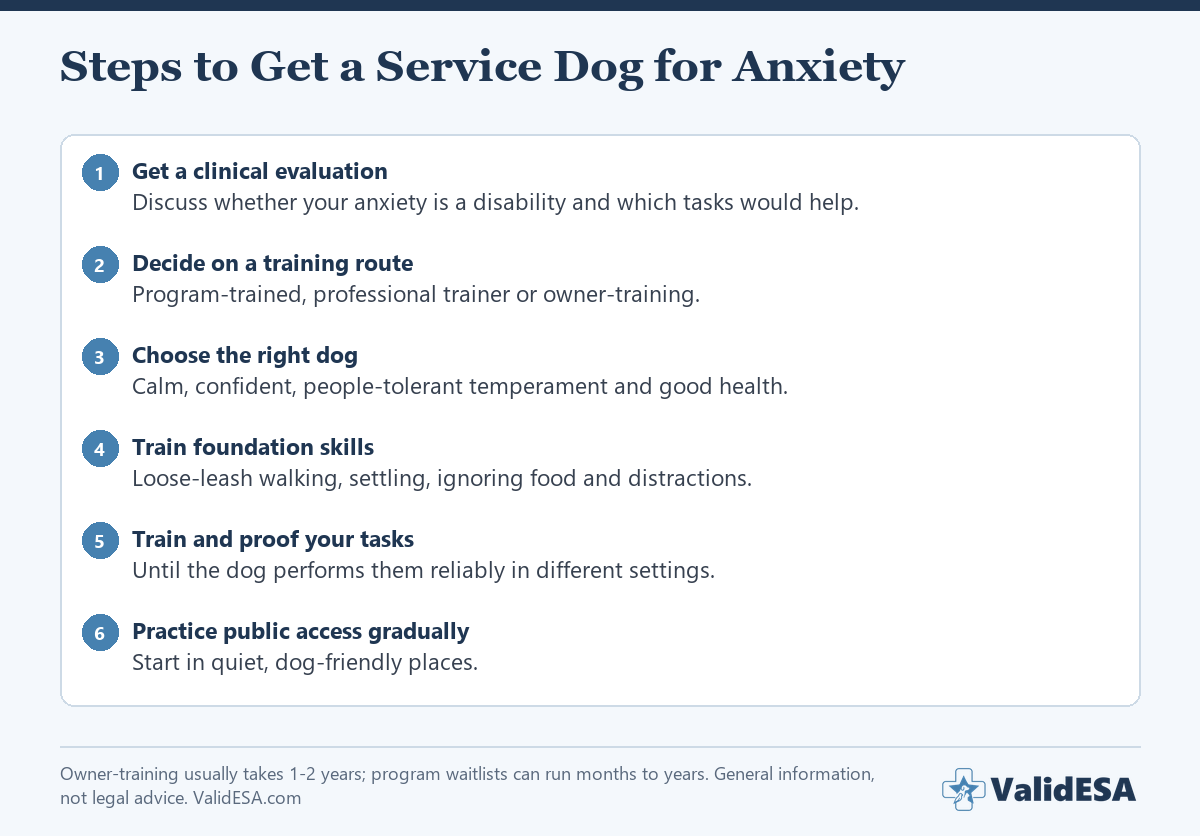
- Get a clinical evaluation. Discuss whether your anxiety is a disability and which tasks would help.
- Decide on a training route: program-trained, professional trainer or owner-training.
- Choose the right dog. Look for a calm, confident, people-tolerant temperament and good health; a trainer's temperament test is worth paying for.
- Train foundation skills and public-access manners: loose-leash walking, settling, ignoring food and distractions.
- Train and proof your specific tasks until the dog performs them reliably in different settings.
- Practice public access gradually, starting in quiet, dog-friendly places.
- Get documentation if you need it for housing or flights - a PSD letter supports those requests but does not replace training.
Program dog vs owner-training
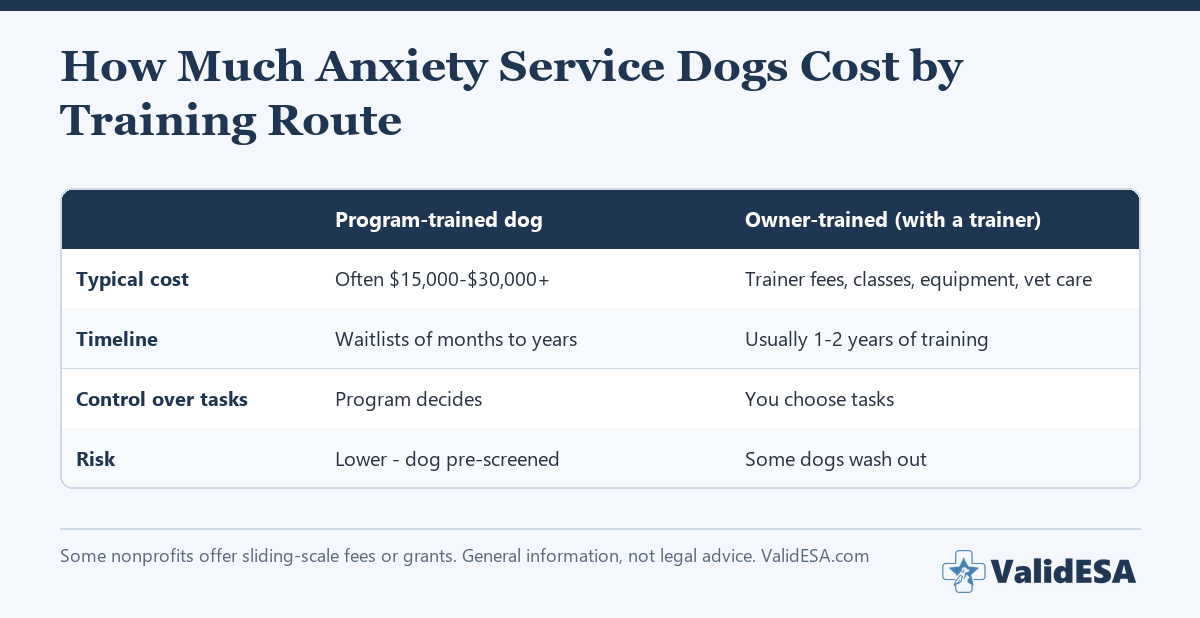
Program-trained dog | Owner-trained (with a trainer) | |
|---|---|---|
Typical cost | Often $15,000-$30,000+ | Trainer fees, classes, equipment, vet care |
Timeline | Waitlists of months to years | Usually 1-2 years of training |
Control over tasks | Program decides | You choose tasks |
Risk | Lower - dog pre-screened | Some dogs wash out |
Owner-training is legal under the ADA. For a staged plan, see train your own psychiatric service dog.
How much are anxiety service dogs?
How much are anxiety service dogs? Program-trained dogs commonly cost $15,000-$30,000 or more, reflecting up to two years of professional training. Owner-training typically runs a few thousand dollars over one to two years for trainers and classes, plus the ordinary cost of keeping a dog. Some nonprofits offer reduced fees or fundraising support. (Unity Service Dogs; Psychiatric Service Dog Partners; 4 Paws 2 Freedom, accessed November 4, 2026.) Health insurance generally does not cover service dogs; HSA/FSA eligibility depends on your plan.
Is there an anxiety dog certification?
No. There is no official anxiety dog certification, service dog registry or ID recognized by federal law. Sites that sell "anxiety dog certification" kits are selling paperwork. Businesses may ask only whether the dog is required because of a disability and what task it performs - they cannot demand a certificate. What matters is training and behavior.
Service dog or ESA for anxiety?
If... | Consider |
|---|---|
You need help in public places (stores, transit, work) | A psychiatric service dog |
Your main need is at home and in housing | An emotional support animal |
You can't commit to 1-2 years of training | An ESA, or a program dog |
Your animal isn't a dog | An ESA (only dogs are ADA service animals) |
An emotional support animal needs no task training and can be a cat or other pet. Its legal protection is mainly in housing; see ESA letter.
How long it takes
With owner-training, most dogs need one to two years to perform tasks reliably and behave well in public. Program dogs are often already trained when placed, but waitlists can be long and handlers usually complete a week or more of team training. Plan for the dog to work for around eight to ten years.
What an anxiety service dog does in a typical day
Moment | Example task |
|---|---|
Morning | Medication reminder at a set time |
Commute | Creating space on a crowded platform |
At work | Interrupting a building panic response with a nudge |
Shopping | Guiding to the nearest exit when overwhelmed |
Evening | Deep pressure therapy to wind down |
Night | Waking the handler during distress |
Choosing a trainer
- Ask whether they have trained psychiatric service dogs specifically.
- Look for positive-reinforcement methods.
- Ask for references from handlers.
- Get a written plan with milestones and costs.
- Avoid anyone who promises "certification" or a fixed date regardless of the dog.
Housing and flights with an anxiety service dog
Under the Fair Housing Act, a trained service dog is an assistance animal, and HUD treats requests for trained animals as presumptively reasonable. A landlord may ask for reliable documentation of a disability-related need if it isn't obvious. For flights, airlines may require the DOT Service Animal Air Transportation Form. A PSD letter supports both.
Paying for a psychiatric service dog for anxiety
- Nonprofit programs with sliding-scale fees
- Grants and fundraising support offered by some programs
- Owner-training to spread costs over time
- Checking whether your HSA or FSA plan treats training costs as eligible (rules vary)
Signs a service dog may help your anxiety
- Panic attacks or severe anxiety keep you from leaving home, working or using transit.
- Your symptoms have physical early signs a dog could learn to detect.
- Specific tasks, such as grounding, deep pressure or creating space, would change what you can do in a day.
- You can commit to training and caring for a working dog for years.
If most of these don't apply, an emotional support animal or other support may fit better. A clinician can help you weigh the options.
Public-access etiquette for new handlers
- Keep your dog at your side and out of aisles.
- Know the two questions staff may ask, and answer briefly.
- Leave if your dog is having an off day; protecting its training matters.
- Ask people not to pet your dog while it is working.
Questions to ask yourself before you start
- Do I have the time each day for training and exercise?
- Can I afford a working dog's care for eight to ten years?
- Will my housing allow a large dog, or do I need to request an accommodation?
- Do I have support for days when my anxiety is worse?
- What will I do if the dog isn't suited to service work?
Honest answers now prevent hard decisions later. Many handlers start with a trainer's consultation before choosing a dog.
Washout: if your dog isn't suited to service work
Not every dog can handle public work. If yours shows persistent fear, reactivity or stress, it can remain a loved pet, and may still qualify as an emotional support animal at home, while you consider a different candidate or a program dog. Pushing an unsuited dog into public places is unfair to the dog and to you.
Common mistakes to avoid
- Buying a "certification" instead of investing in training
- Taking a dog into public places before it is ready
- Choosing a puppy for looks rather than temperament
- Calling an untrained dog a service dog - misrepresentation is penalized in many states
- Skipping the clinician conversation
Need housing protection now? Get an ESA letter Training a PSD? Get your PSD letter
Conclusion: getting a service dog for anxiety
A service dog for anxiety is possible when anxiety is a disability and the dog is trained for specific tasks. Start with a clinician, pick a training route you can sustain, and skip certificates. If your animal helps mainly by being there, an emotional support animal may be the simpler, faster option.
Frequently asked questions
Can you get a service dog for anxiety?
Yes, if your anxiety is a disability that substantially limits daily life and the dog is individually trained to perform tasks that help, such as deep pressure therapy or panic interruption.
What tasks does an anxiety service dog do?
Common tasks include deep pressure therapy, interrupting panic symptoms, grounding, creating space in crowds, guiding to an exit and retrieving medication.
How much does a service dog for anxiety cost?
Program-trained dogs commonly cost $15,000-$30,000 or more. Owner-training costs less but usually takes one to two years.
Is there an official anxiety dog certification?
No. Federal law has no service dog certification or registry, and businesses cannot require one.
Is an ESA or a service dog better for anxiety?
It depends on where you need help. Service dogs have public-access rights but need task training; ESAs need no training and mainly help in housing.
How long does it take to train an anxiety service dog?
Usually one to two years with owner-training. Program-trained dogs arrive trained, but waitlists can be long.
Can a small dog be an anxiety service dog?
Yes, for tasks like interrupting behaviors or medication reminders. Deep pressure therapy usually works better with a medium or large dog.
Can I take my anxiety service dog to work?
Possibly. At work, a service dog is a reasonable accommodation request under ADA Title I, which your employer considers case by case.
Do I need a doctor's note for an anxiety service dog?
Not to enter public places; businesses cannot require documentation. A letter can help with housing requests and with the DOT form airlines may require.
Can my current dog become an anxiety service dog?
Possibly, if it has a suitable temperament and can be trained to perform tasks reliably. A trainer's evaluation is a good first step.
Sources
- ADA Title III regulations, 28 C.F.R. §§ 36.104, 36.302(c); ADA.gov "Frequently Asked Questions about Service Animals and the ADA"
- Anxiety & Depression Association of America: adaa.org
- Assistance Dogs International standards: assistancedogsinternational.org
- National Institute of Mental Health: nimh.nih.gov
This article is for general information and is not legal or medical advice. Laws and agency enforcement policies change; check the cited sources or speak with a qualified attorney or licensed clinician about your situation.
Related reading
- Psychiatric service dogs
- How to get a service dog for PTSD
- Train your own psychiatric service dog
- PSD letter