
Fair Housing Act & Emotional Support Animals: A Renter's Guide to HUD's 2026 Rules
By the ValidESA Editorial Team · Reviewed by Dr Anita Sanders · Last updated:

Quick answer (AI snippet)
The Fair Housing Act lets people with disabilities request a reasonable accommodation, such as keeping an emotional support animal in no-pet housing. Since May 22, 2026, HUD pursues complaints only for task-trained animals, but the Act itself, private lawsuits and many state laws still protect ESA owners.
Key takeaways
- The Fair Housing Act (42 U.S.C. § 3604(f)) still requires reasonable accommodations for people with disabilities; Congress has not changed it.
- HUD withdrew its 2020 ESA guidance effective September 17, 2025. Its May 22, 2026 memorandum reconfirmed the withdrawal and now finds reasonable cause only for individually trained animals.
- Tenants can still sue within two years, and state laws such as California's FEHA still protect untrained ESAs.
- Landlords may ask for reliable documentation when a disability isn't obvious, but not for a diagnosis or medical records.
- Owner-occupied buildings of four or fewer units and some single-family rentals are exempt from the FHA.
Fair housing and emotional support animals: the 2026 answer
Fair housing and emotional support animals are still connected by one federal rule: housing providers must make reasonable accommodations for people with disabilities. What changed in 2026 is how HUD enforces that rule for animals that are not trained to do tasks. Many pages answering "fair housing act ESA," "FHA ESA" or "HUD ESA" searches still quote 2020 guidance that no longer applies.
Are ESA animals protected under the Fair Housing Act?
Are ESA animals protected under the Fair Housing Act? Partly. The statute protects people with disabilities, not animals, and an ESA can be a reasonable accommodation for a person with a disability-related need. Since May 22, 2026, HUD will find reasonable cause on a complaint only when the animal is individually trained to do work or tasks. An ESA Fair Housing Act request for an untrained animal still has routes: private lawsuits under the FHA and state fair housing laws.
What the FHA and Section 504 actually say
The Fair Housing Act was passed in 1968; the Fair Housing Amendments Act of 1988 added disability (the statute says "handicap"). Two provisions form the core of fair housing act emotional support animal law:
- 42 U.S.C. § 3604(f)(3)(B): refusing "reasonable accommodations in rules, policies, practices, or services" needed for equal use of a dwelling is discrimination.
- 24 C.F.R. § 100.204: HUD's regulation applying that rule; its classic example is allowing a guide dog in a no-pets building.
Section 504 of the Rehabilitation Act of 1973 adds similar duties for federally assisted housing. Searches for "fair housing act section 504 emotional support animal 2024" usually look for the 2020 HUD rules that applied in 2024; that guidance was withdrawn effective September 17, 2025. Section 504 itself is unchanged. Neither law uses the words "emotional support animal" - ESA protection came from HUD interpretations and court decisions.
HUD ESA guidance: from FHEO-2020-01 to the 2026 change
What FHEO-2020-01 said (2020-2025)
On January 28, 2020, HUD issued notice FHEO-2020-01 on assessing animal accommodation requests. It treated untrained "support animals" as possible accommodations, used a two-question test (disability; disability-related need), allowed reliable documentation when needs weren't obvious, said online certificates alone were not enough and told providers not to charge pet fees for assistance animals.
What changed in September 2025 and May 2026
- September 2025: HUD withdrew a group of fair-housing guidance documents, including FHEO-2020-01.
- May 22, 2026: a memo signed by FHEO Assistant Secretary Craig W. Trainor reconfirmed the withdrawal of FHEO-2013-01 and FHEO-2020-01, effective September 17, 2025. HUD now finds reasonable cause only where the animal is individually trained to do work or perform tasks related to the disability - a test borrowed from the ADA that may apply to species other than dogs.
- HUD said requests for trained animals remain "presumptively reasonable," that open ESA cases would be reviewed case by case and that it plans notice-and-comment rulemaking.
What did NOT change
- The statute: the FHA's reasonable-accommodation duty is the same.
- Private lawsuits: you can still sue within two years of the discriminatory act (42 U.S.C. § 3613).
- State and local law: California's Civil Rights Department stated in a July 20, 2026 legal alert that FEHA and the Unruh Act still protect untrained assistance animals.
- Courts: HUD guidance never bound judges; one federal court had already called the 2020 notice "unpersuasive" (Henderson v. Five Properties LLC, E.D. La., July 16, 2025).
Fair housing law, service animals and ESAs compared
Fair housing law service animals rules differ from ADA public-access rules. Under the FHA, an ESA FHA request is a housing accommodation only; it gives no right to bring the animal into stores or onto planes.
Service animal (ADA) | Trained assistance animal (FHA, HUD 2026) | Emotional support animal | |
|---|---|---|---|
Training | Individually trained for tasks | Individually trained for disability-related tasks | No task training required |
Species | Dogs (some miniature horses) | Any species, if trained | Common domestic animals |
HUD enforcement (2026) | Yes | Yes, presumptively reasonable | No reasonable-cause finding |
State housing law | Protected | Protected | Protected in many states |
For airlines, public places and other federal laws, see our overview of emotional support animal laws. If your dog is task-trained, read about the psychiatric service dog letter.
Fair Housing Act ESA letter: what HUD's rules let a landlord ask
There is no official "HUD ESA letter" or "HUD emotional support animal letter" form - HUD never issued one. A Fair Housing Act ESA letter is documentation from a licensed clinician that confirms a disability and a disability-related need for the animal. It is the core document in any emotional support animal Fair Housing Act request.
Landlords generally CAN | Landlords generally CANNOT |
|---|---|
Ask for reliable documentation when the disability or need isn't obvious | Demand your diagnosis, medical records or therapy notes |
Verify that the clinician and license are real | Require a paid certificate, registry ID or their own form |
Hold you responsible for actual damage | Deny based on breed stereotypes alone where state law protects ESAs |
For what the letter itself should contain, see ESA letter for housing.
Pet fees and deposits under fair housing rules
Under the rescinded 2020 guidance, landlords were told not to charge pet fees, pet rent or deposits for assistance animals. After May 2026, federal enforcement of that point for untrained ESAs is uncertain. State law often fills the gap - California's Civil Rights Department lists waiving pet fees and breed restrictions as reasonable accommodations. Check your state: California ESA letters, Washington ESA letters or ESA rules by state. You can still be charged for actual damage.
When a fair housing ESA request can lawfully be denied
The fair housing act ESA law has always allowed some denials, including for a fair housing act emotional support dog:
- No disability, or no disability-related need for the animal
- Unreliable documentation, such as a certificate with no clinician behind it
- A direct threat from the specific animal that can't be reduced (42 U.S.C. § 3604(f)(9))
- Substantial physical damage to others' property by the specific animal
- An undue financial and administrative burden
- A fundamental alteration of the provider's operations
- Housing exempt from the FHA
For untrained ESAs, HUD now also won't find reasonable cause. For the full denial guide, read can a landlord deny an emotional support animal.
Housing the FHA doesn't cover
- Owner-occupied buildings with no more than four units where the owner lives in one (42 U.S.C. § 3603(b)(2)).
- Certain single-family homes rented by an owner of no more than three such homes, without a broker or discriminatory advertising (§ 3603(b)(1)).
- Religious organizations and private clubs, in limited circumstances (§ 3607).
State laws may cover housing the FHA exempts, and the FHA's advertising rules still apply.
Timeline of fair housing emotional support animal rules
- 1968: Fair Housing Act passed.
- 1988: disability and the reasonable-accommodation duty added.
- 2013: HUD issues FHEO-2013-01.
- January 28, 2020: HUD issues FHEO-2020-01.
- January 11, 2021: DOT rule - airlines may treat ESAs as pets.
- July 16, 2025: Henderson v. Five Properties calls the 2020 notice "unpersuasive."
- September 2025: HUD withdraws FHEO-2020-01.
- May 22, 2026: HUD reconfirms the withdrawal of FHEO-2013-01 and FHEO-2020-01, effective September 17, 2025.
- July 20, 2026: California confirms state protection for untrained assistance animals.
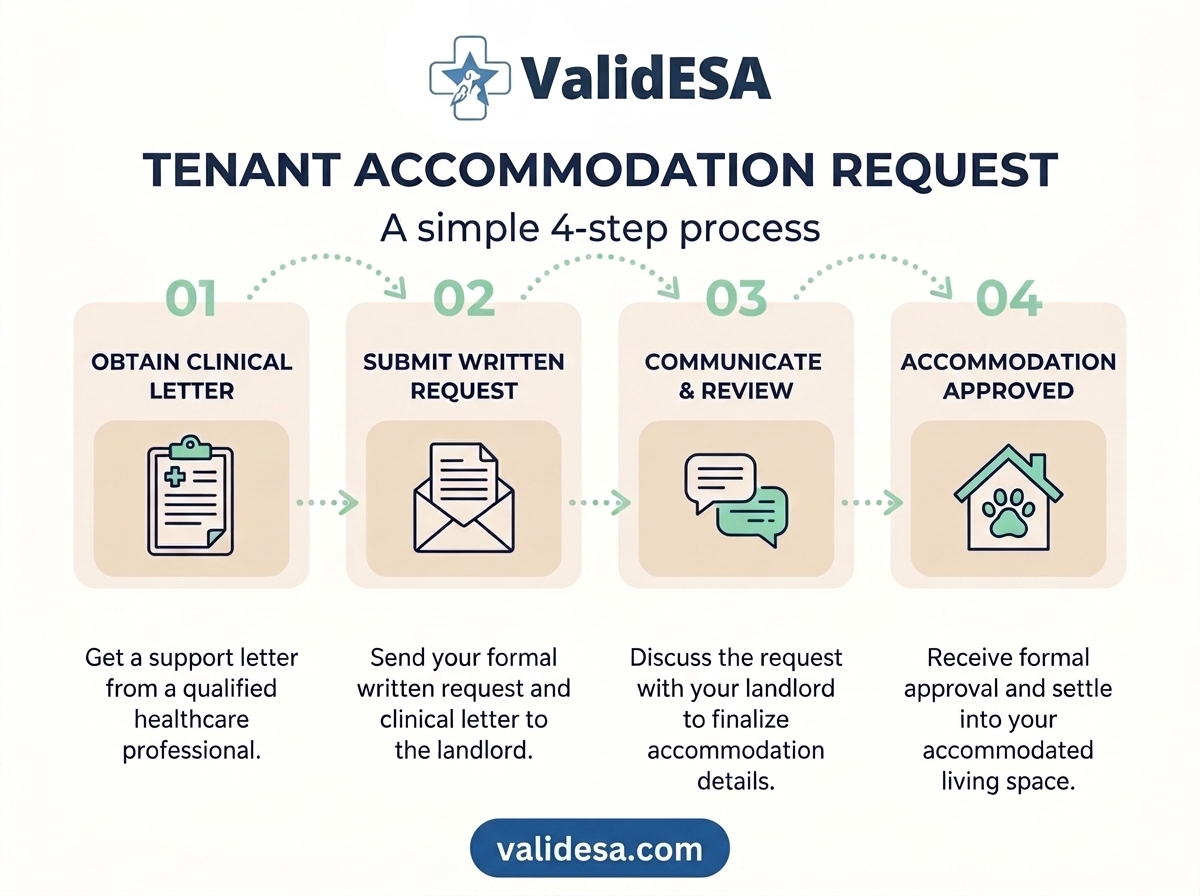
Step-by-step: making a fair housing ESA request
- Get documentation from a licensed clinician if your disability isn't obvious - see how to get an ESA letter.
- Put the request in writing: you have a disability-related need for the animal and ask for an exception to the pet policy. You can do this before signing or after you move in.
- Attach the letter, not your medical records.
- Answer reasonable questions and consider workable alternatives.
- Keep a record of every message and date.
- If denied, ask for written reasons, then contact a fair housing organization, your state civil-rights agency or an attorney. HUD complaints must be filed within one year (42 U.S.C. § 3610).
Need a landlord-ready letter from a licensed clinician? Start your assessment.
Reasonable accommodation vs reasonable modification
The FHA uses two different tools. A reasonable accommodation is a change to a rule or policy - waiving a no-pets rule for an ESA is the classic example (42 U.S.C. § 3604(f)(3)(B)). A reasonable modification is a physical change to the unit, such as a ramp or grab bar, which the tenant usually pays for in private housing (§ 3604(f)(3)(A)). An ESA request is almost always an accommodation, so the landlord bears the cost of changing the policy, not you.
The interactive process and response times
The Fair Housing Act does not set a fixed number of days to answer an ESA request, but HUD and courts have long treated an unreasonable delay as a denial. A good-faith "interactive process" means the landlord answers promptly, asks only for information it genuinely needs and discusses alternatives instead of refusing outright.
- Send the request in writing and keep the date.
- If you hear nothing within about 10 business days, follow up in writing.
- Answer reasonable follow-up questions; decline requests for your diagnosis or records.
- If the landlord proposes an alternative (a different unit, a smaller animal), respond in writing either way.
Some states set their own deadlines or procedures - check your state's page in ESA rules by state.
Section 504 and federally assisted housing
If you live in public housing, HUD-assisted housing or another federally funded program, Section 504 of the Rehabilitation Act applies alongside the FHA. Section 504 has its own reasonable-accommodation duty and its own regulations (24 C.F.R. Part 8). The May 2026 memo reconfirmed the withdrawal of HUD's FHA guidance documents; it did not repeal Section 504. Public housing agencies usually have written accommodation policies - ask for a copy.
Filing a HUD complaint vs going to court
Route | Deadline | Best for (2026) |
|---|---|---|
HUD complaint (FHEO) | 1 year from the act (42 U.S.C. § 3610) | Task-trained animals; HUD may still review ESA cases case by case |
State civil-rights agency | Varies by state | Untrained ESAs in states whose law protects them |
Private lawsuit (federal or state court) | 2 years (42 U.S.C. § 3613) | Any FHA claim, including untrained ESAs |
Local fair housing organization | Ask early | Free advice, testing and help filing |
Many fair housing organizations offer free help. An attorney can tell you whether your facts support a claim under federal or state law.
Real-world examples under the 2026 rules
Example 1 - untrained ESA cat in Los Angeles. A tenant with documented anxiety asks to keep a cat in a no-pets building. HUD won't find reasonable cause if the landlord refuses, but California's FEHA still requires the landlord to consider the request and generally to waive pet fees. The tenant can file with the California Civil Rights Department.
Example 2 - task-trained psychiatric service dog in Texas. The dog is trained to interrupt panic episodes. Under HUD's 2026 policy the request is presumptively reasonable, and HUD can investigate a refusal.
Example 3 - ESA dog in a four-unit building where the owner lives. The owner-occupied exemption (42 U.S.C. § 3603(b)(2)) may take the building outside the FHA, although state law may still apply.
What housing providers should do now
- Keep a written accommodation policy that distinguishes trained assistance animals from untrained ESAs and follows state law.
- Respond promptly and in writing; document the interactive process and every decision.
- Assess each animal individually, not by breed or size, in states that protect ESAs.
- Use a consistent way to confirm letters - for example, verify a tenant's ESA letter.
- Watch the Federal Register for HUD's promised rulemaking and get fair housing counsel before changing policies.
Conclusion: fair housing and emotional support animals after 2026
Fair housing and emotional support animals are still linked by the Fair Housing Act's reasonable-accommodation rule, but HUD no longer backs untrained ESAs in its own enforcement. Your strongest protection is a verifiable letter from a licensed clinician, a written request and your state's fair housing law.
Frequently asked questions
Does the Fair Housing Act cover emotional support animals?
The FHA covers reasonable accommodations for people with disabilities, which can include an ESA. Since May 22, 2026, HUD finds reasonable cause only for individually trained animals, but tenants can still sue under the FHA and many state laws still protect ESAs.
What is HUD FHEO-2020-01?
HUD's January 2020 notice on animal accommodation requests. HUD withdrew it effective September 17, 2025, and reconfirmed the withdrawal on May 22, 2026, so it is no longer current guidance.
Is there an official HUD ESA letter?
No. HUD never issued an ESA letter form. A Fair Housing Act ESA letter is documentation from a licensed clinician confirming a disability and a disability-related need for the animal.
Can a landlord charge a pet fee for an ESA under the Fair Housing Act?
The rescinded 2020 guidance said no. Federal enforcement is now uncertain for untrained ESAs, but many state laws, including California's, still treat waiving pet fees as a required accommodation.
Which housing is exempt from the FHA?
Owner-occupied buildings with four or fewer units, certain single-family homes rented without a broker by owners of no more than three homes, and some religious organizations and private clubs. State laws may still apply.
Does Section 504 still apply to ESAs after 2026?
Yes. Section 504 of the Rehabilitation Act still requires reasonable accommodations in federally assisted housing. The May 2026 memo reconfirmed the withdrawal of HUD's FHA guidance documents, not Section 504.
How long do I have to file a fair housing complaint?
One year to file with HUD (42 U.S.C. § 3610) and two years to sue in court (§ 3613). State agencies have their own deadlines.
Does the Fair Housing Act apply to condos and HOAs?
Yes. Condominium and homeowners associations are covered by the FHA, so an owner or tenant can ask an HOA for a reasonable accommodation to a pet rule. State law may add protections.
Can a landlord require my ESA to be trained?
For untrained ESAs, HUD no longer finds reasonable cause after May 2026, so training now matters for federal enforcement. Many state laws still protect untrained ESAs, and any animal must be under control and not a direct threat.
Sources
- Fair Housing Act, 42 U.S.C. §§ 3601-3619 (incl. §§ 3603(b), 3604(f), 3607, 3610, 3613)
- 24 C.F.R. § 100.204
- Section 504, Rehabilitation Act of 1973, 29 U.S.C. § 794
- HUD FHEO-2020-01 (Jan. 28, 2020) - withdrawn effective September 17, 2025; withdrawal reconfirmed May 22, 2026
- Holland & Knight, "HUD Rescinds Emotional Support Animal Guidance" (June 2026): hklaw.com
- California Civil Rights Department, ESA legal alert (July 20, 2026): calcivilrights.ca.gov
- Henderson v. Five Properties LLC, No. 24-750 (E.D. La. July 16, 2025)
This article is for general information and is not legal or medical advice. Laws and agency enforcement policies change; check the cited sources or speak with a qualified attorney or licensed clinician about your situation.