
Can You Have Two Emotional Support Animals? ESA Letters for 2 Dogs, 2 Cats or One of Each
By the ValidESA Editorial Team · Reviewed by Dr Anita Sanders · Last updated:
Quick answer (AI snippet)
Yes, you can have two emotional support animals if a licensed clinician determines each animal helps with a disability-related need. An emotional support animal letter for two dogs (or cats) should address both animals. Landlords assess each animal individually and may limit or deny for specific reasons such as space, direct threat or undue burden.
Key takeaways
- Two ESAs are possible when each animal serves a disability-related need your clinician documents.
- One letter can cover two animals if it addresses each; separate letters also work.
- Landlords assess each animal individually and can deny for lawful, specific reasons.
- Pet limits generally don't apply to approved ESAs in states that protect them, but federal enforcement narrowed in 2026.
- Make one clear written request covering both animals, before they move in.
Short answer
Can I have two emotional support animals? Yes, if each animal helps with a disability-related need, as determined by a licensed clinician. An emotional support animal letter for two dogs, two cats, or a dog and a cat should explain each animal's role. Landlords evaluate the request case by case; approval isn't automatic.
How landlords assess multiple assistance animals
Housing providers look at the request as a whole and at each animal individually:
- Is there a disability-related need for each animal? The letter should address this.
- Does either animal pose a direct threat or risk substantial damage, based on its actual behavior?
- Is the request reasonable for the unit, considering size, building rules and local occupancy or animal-limit ordinances?
- Would it be an undue financial or administrative burden?
Since May 22, 2026, HUD finds reasonable cause on federal complaints only for trained animals, so for untrained ESAs, your state's law largely determines how strictly landlords must accommodate. See can landlords deny an ESA.
What your letter should say for two animals
Do I need a separate letter for each ESA? Not necessarily. One letter can cover both if it:
- Names or describes each animal (species, name)
- States that you have a disability
- Explains, in general terms, that each animal helps with a disability-related need. For example, one helps with sleep disruption while the other supports daily routine. No diagnosis is needed.
- Includes clinician letterhead, license type, number and state, date and signature
Does an ESA letter cover multiple pets? Only the animals it addresses. A letter for one dog doesn't automatically cover a second animal.
When a landlord may limit or deny
- Direct threat: one dog has a bite history that can't be mitigated.
- Substantial damage: documented, specific risk from a particular animal.
- Undue burden: for example, a very small unit where two large dogs would create real problems.
- Local law limits: city ordinances may cap animals per household, though accommodation rules may still apply.
- Unreliable documentation: a letter that doesn't address the second animal.
Can a landlord limit the number of ESAs? Not with a blanket rule in states that protect ESAs. Decisions should be individualized. But a landlord can deny a specific animal for a lawful, specific reason.
Two dogs vs dog + cat: practical differences
Two dogs | Dog + cat | Two cats | |
|---|---|---|---|
Space and noise | Highest | Moderate | Lowest |
Landlord concerns | Barking, damage, size | Litter, scratching | Litter, odor |
Insurance | Check breed exclusions for both | Usually simpler | Usually simplest |
Approval tips | Show training and calm behavior | Show litter plan and dog manners | Show litter plan |
Can I have an ESA dog and an ESA cat? Yes, if each helps with a disability-related need. See how to get a letter for an emotional support dog and B21 (cats).
Scenario boxes
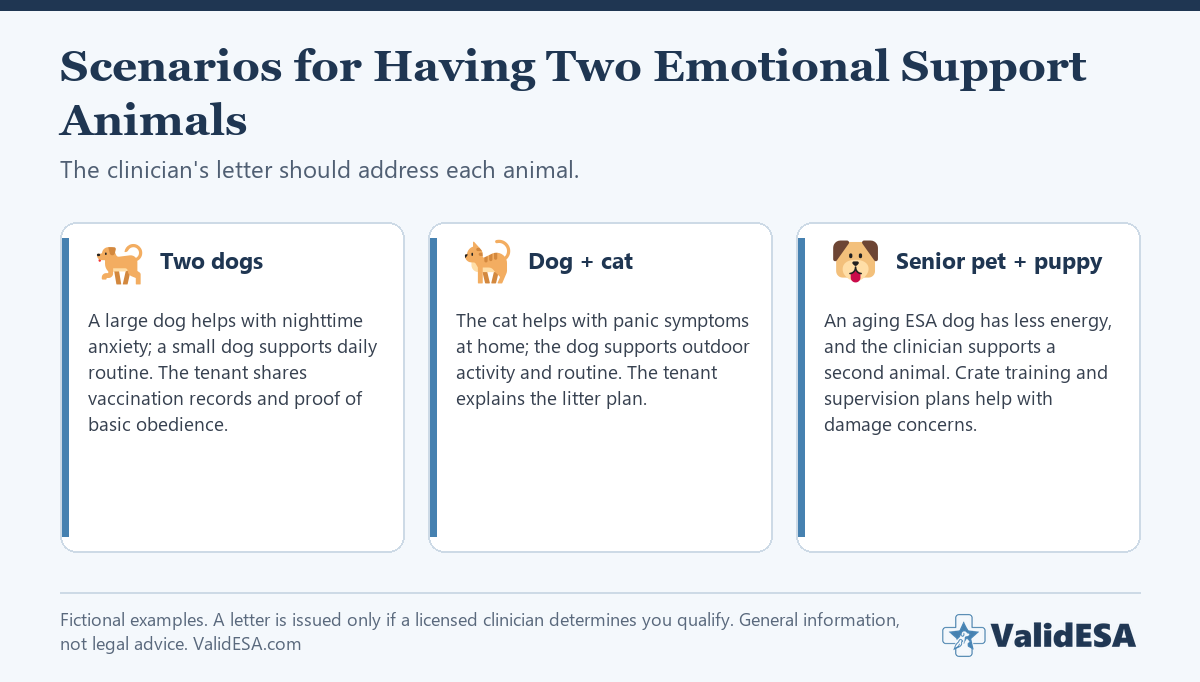
Two dogs
A tenant with PTSD has a large dog that helps with nighttime anxiety and a small dog that supports daily routine. The clinician's letter addresses both; the tenant shares vaccination records and offers proof of basic obedience.
Dog + cat
A tenant's cat helps with panic symptoms at home; the dog supports outdoor activity and routine. The letter addresses both; the tenant explains the litter plan.
Senior pet + puppy
A tenant's aging ESA dog has less energy, and the clinician supports adding a second animal. The landlord may weigh puppy-related damage risk; crate training and supervision plans help.
Step-by-step: requesting approval for two ESAs
- Talk to your clinician about each animal's role. The clinician decides whether both are supported.
- Get a letter that addresses both animals.
- Write one clear request to your landlord covering both animals, with species, names and sizes.
- Offer reassurance: vaccination records, licenses, training notes and renters insurance.
- Answer follow-up questions promptly (interactive process).
- Get written approval for both animals before they move in.
Sample request wording
"I'm requesting a reasonable accommodation to live with my two emotional support animals, [name, species] and [name, species], at [address]. My licensed clinician's letter addressing both animals is attached. I'm happy to provide vaccination records and discuss any concerns."
Start your ESA assessment Learn about our ESA letter for dog or how to get an ESA letter.
How to make a two-animal request stronger
- Show manners: basic obedience, house-training and calm behavior for both animals
- Show care: vaccination records, local licenses, vet contact
- Show space planning: where each animal sleeps, crates, litter boxes
- Show liability coverage: renters insurance covering both animals
- Be flexible: if the landlord has a concern, offer reasonable alternatives during the interactive process
Common mistakes with two ESAs
- A letter that mentions only one animal
- Bringing the second animal home before requesting approval
- Assuming approval for one animal covers a new one later
- Ignoring local animal-limit ordinances without discussing them
Two ESAs and renters insurance
Before requesting approval for two animals, confirm your renters insurance covers both, especially if either is a large dog or a breed some insurers limit. Many landlords feel more comfortable approving two animals when the tenant shows liability coverage. See B03 and B15.
What happens if one ESA passes away or is rehomed?
Tell your landlord in writing. If you later want a new ESA, make a new accommodation request with updated documentation that addresses the new animal. Approval for the original animal doesn't automatically transfer.
Fees, deposits and pet limits for multiple ESAs
- Pet limits: in states that protect ESAs, approved ESAs generally don't count toward pet limits.
- Pet fees and pet rent: California's Civil Rights Department treats waiving pet fees as a reasonable accommodation. After HUD's 2026 change, federal enforcement for untrained ESAs is uncertain, so check your state.
- Security deposit: the normal deposit still applies.
- Damage: you're responsible for actual damage by either animal.
Conclusion: an emotional support animal letter for two dogs
An emotional support animal letter for two dogs, or any two animals, works when your clinician addresses each animal's role. Make one clear written request, show you can manage both animals, and expect the landlord to assess each one individually.
Related reading
How to get a letter for an emotional support dog
Register cat as emotional support animal
ESA letter for apartment
Frequently asked questions
Can I have two emotional support animals?
Yes, if a licensed clinician determines each animal helps with a disability-related need. Landlords assess each animal individually.
Do I need a separate letter for each ESA?
Not necessarily. One letter can cover both animals if it addresses each one's role. Separate letters also work.
Can a landlord limit the number of ESAs?
Not with a blanket rule in states that protect ESAs, but a landlord can deny a specific animal for lawful reasons such as direct threat, substantial damage or undue burden.
Can I have an ESA dog and an ESA cat?
Yes, if each animal helps with a disability-related need documented by your clinician.
Does an ESA letter cover multiple pets?
Only the animals it specifically addresses. A letter for one animal doesn't automatically cover a second.
Can I have three or more ESAs?
Possibly, if each animal serves a disability-related need your clinician documents, but landlords assess each animal individually and may deny for undue burden, space or direct-threat reasons. Approval becomes harder with more animals.
Does my second ESA need to be the same species?
No. Each animal can be any common household species if it helps with a disability-related need.
Will my landlord charge pet rent for two ESAs?
In states that protect ESAs, approved ESAs generally aren't charged pet rent. After HUD's 2026 change, federal enforcement for untrained ESAs is uncertain, so check your state.
Can my landlord approve one ESA but not the other?
Yes. Landlords assess each animal individually and may approve one while denying the other for a specific, lawful reason such as a direct threat from that animal.
Do I need two separate requests for two ESAs?
One clear written request covering both animals is usually best, with a letter that addresses each animal.
Sources
- Fair Housing Act, 42 U.S.C. § 3604(f)(3)(B); 24 C.F.R. § 100.204
- HUD FHEO assistance-animal rescission (September 17, 2025); Holland & Knight (June 2026): hklaw.com
- California Civil Rights Department ESA Legal Alert (July 20, 2026)
This article is for general information and is not legal or medical advice. Laws and agency enforcement policies change; check the cited sources or speak with a qualified attorney or licensed clinician about your situation.