
Free ESA Registration & Certificates: Why There Is No Official ESA Registry
By the ValidESA Editorial Team · Reviewed by Dr Anita Sanders · Last updated:
Quick answer (AI snippet)
There is no official ESA registry or government ESA certification in the United States. Free ESA certification, registration and ID-card websites sell private products with no legal weight. For housing, landlords look for a letter from a licensed clinician who evaluated you. Emotional support animals don't need to be registered.
Key takeaways
- No federal or state agency runs an emotional support animal registry. 'Official' ESA registration doesn't exist.
- Free ESA certification sites make money from upsells: certificates, ID cards, vests and subscriptions.
- A certificate or ID card doesn't prove a disability-related need. Florida's law says online registrations aren't, by themselves, sufficient.
- What counts for housing is a letter from a licensed clinician who evaluated you.
- Vests and ID cards are optional accessories, never legal requirements.
Free ESA certification: the short answer (no official ESA registry exists)
Searching for free ESA certification or a "free ESA" registry turns up dozens of sites offering certificates, registration numbers and ID cards. None of them is official. The U.S. government, HUD and state governments don't certify or register emotional support animals. Do emotional support animals need to be registered? No.
For housing, the document that matters is an ESA letter from a licensed mental health professional, or another licensed clinician, who evaluated you and confirmed a disability-related need for your animal. Read our free ESA letter guide to see what a legitimate letter looks like and when it can be free.
What ESA 'certification', 'registration' and 'ID cards' really are
Product | What it actually is | Legal weight |
|---|---|---|
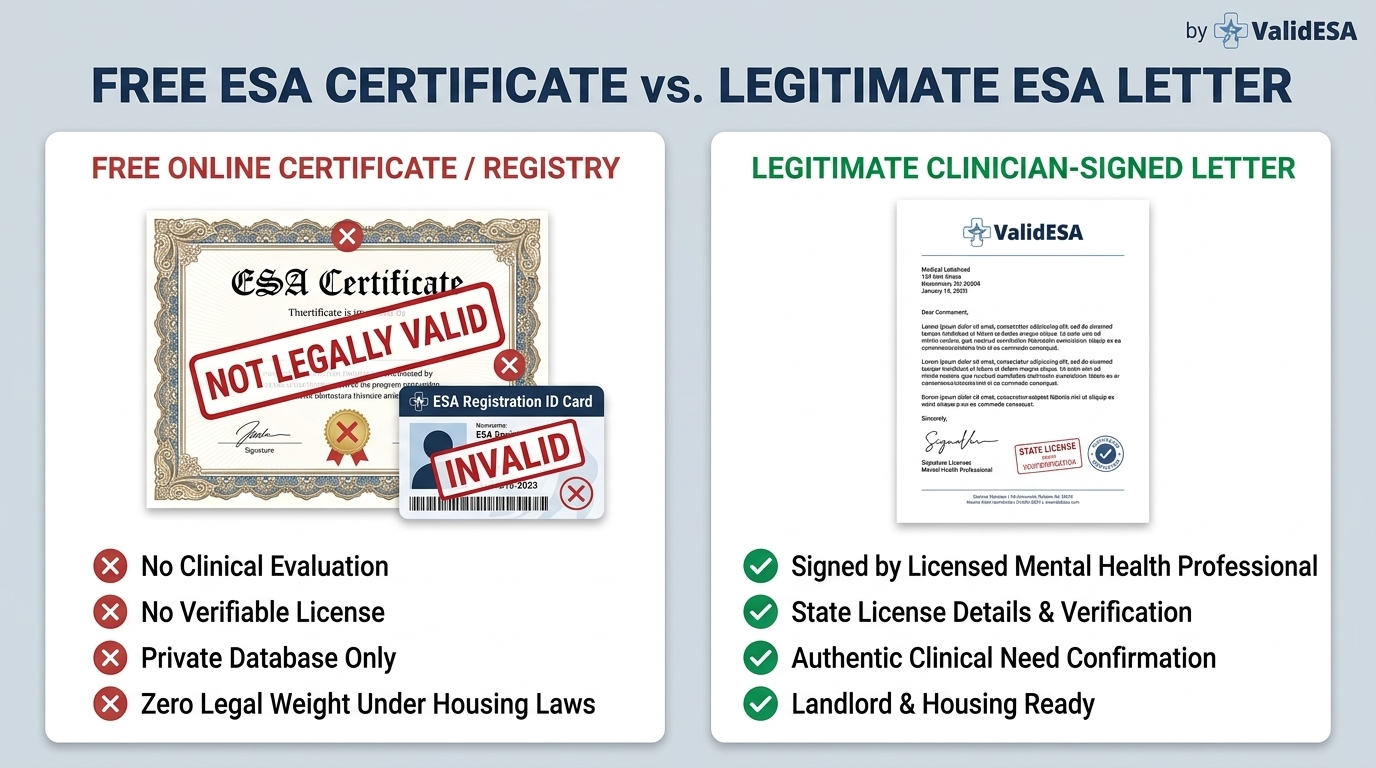
ESA certificate (free or paid) | A printable document from a private website | None |
ESA registration / registry number | An entry in a company's private database | None |
ESA identification card / emotional support animal ID | A plastic or printable card with your animal's photo | None |
ESA vest | A clothing accessory | None (optional) |
ESA letter from a licensed clinician | Disability-related documentation after an evaluation | Supports a housing accommodation request |
A free emotional support animal certificate or free emotional support animal certification looks official, often with seals, numbers and the word "certified." That's design, not law.
Why the 'certification' idea is misleading
"Certification" implies a standards body tested the animal or the owner. No such body exists for ESAs. ESAs aren't required to have training, and only a clinician can confirm the disability-related need that housing law cares about. ESA certification online, sometimes sold as ESA online certification, skips the only step that matters: a clinical evaluation.
Service dog 'registries' are the same story
Private service dog registries also have no legal status. Under the ADA, businesses may ask only two questions about a service dog: whether it's required because of a disability, and what work or task it's trained to perform. They can't require registration or ID (28 C.F.R. § 36.302(c)(6)).
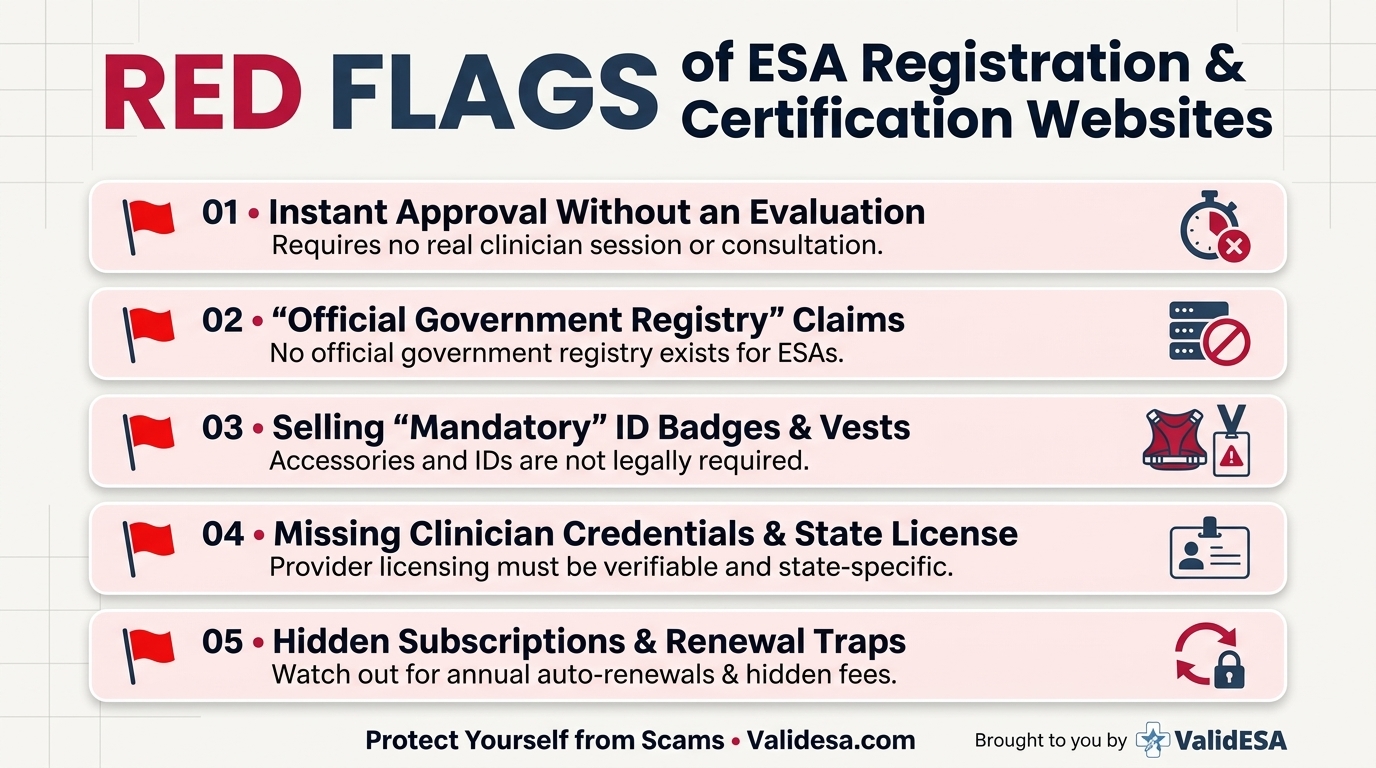
Free ESA certificate sites: how they make money
ESA free offers are rarely free. Typical business models:
- Upsells. The free certificate is a lead magnet for paid ID cards, vests, leash tags and "premium" kits.
- Subscriptions. Annual "renewal" of a registration that never had legal value.
- Data collection. Your email and phone number are used for marketing.
- Letter add-ons. Some sites bundle a template letter with no real clinician behind it.
People shopping for the cheapest ESA certification or ESA certification online free often end up paying for several of these add-ons, and still don't have documentation a landlord has to consider.
Is an ESA certificate legally valid?
No. A certificate, registration or ID card doesn't establish that you have a disability or that the animal helps with a related need.
- Federal: HUD's former guidance (FHEO-2020-01, withdrawn effective September 17, 2025) said certificates and registrations bought online weren't, on their own, reliable documentation. Since May 2026, HUD pursues complaints only for individually trained animals, so weak documentation carries even less weight federally.
- State example, Florida: Fla. Stat. § 760.27 (2020) says an ESA registration of any kind, including an ID card, patch or certificate obtained online, isn't by itself sufficient to establish a disability or disability-related need. Florida also makes falsifying ESA documentation a second-degree misdemeanor (Fla. Stat. § 817.265).
- State example, California: AB 468 (Health & Safety Code § 122318) requires a 30-day client relationship and clinical evaluation before a practitioner documents a need for an emotional support dog.
What landlords actually accept instead
Landlords look for a letter from a licensed clinician that includes:
- Clinician letterhead and contact details
- Name, license type, license number and issuing state
- Date of issue and signature
- A statement that you have a disability
- A statement that the animal helps with a disability-related need
Landlords can verify the license on the state licensing board's website. See how to verify an ESA letter. To get one, see how to get an ESA letter.
Skip the registry. Get a clinician-reviewed letter. Start your assessment.
Do you need a vest or ID card for your ESA?
No. Vests and ID cards are optional. Some owners like a vest to signal "please don't pet," and that's fine, but:
- No housing law requires a vest or ID card for an ESA.
- A vest doesn't give an ESA access to stores, restaurants or planes. ESAs have no ADA public-access rights, and airlines haven't had to accept ESAs since January 11, 2021.
- Wearing a "service dog" vest on an ESA can be misrepresentation. Many states, including California (Penal Code § 365.7), penalize falsely representing a dog as a service dog.
What to do if you already bought an ESA certificate
Many people buy a certificate before learning it has no legal weight. If that's you:
- Don't rely on it for a housing request.
- Ask for a refund if the site promised "official" status, and dispute the charge with your card issuer if needed.
- Cancel any subscription attached to the purchase.
- Report misleading claims at ReportFraud.ftc.gov.
- Get a real evaluation from a licensed clinician. If you qualify, you'll receive a letter your landlord can verify.
Free ESA certification vs. a real ESA letter at a glance
Question | Free ESA certification | ESA letter |
|---|---|---|
Does a clinician evaluate you? | No | Yes |
Can a landlord verify it? | No | Yes, by license lookup |
Does it prove a disability-related need? | No | Yes, if issued after evaluation |
Is it required by law? | No | It's the documentation landlords may request |
Cost | Often "free," then upsells | Varies; may be free from your own therapist |
Why 'official-looking' ESA products persuade people
Registry sites borrow the look of government documents: seals, ID numbers, holograms and words like "national" or "official." Some also confuse ESAs with service dogs. Remember: no government agency issues ESA certificates, and real disability documentation always names a licensed clinician.
How to protect yourself from ESA registry scams
- Never pay for "registration." It doesn't exist officially.
- Look for a real evaluation with a clinician licensed in your state.
- Check the license number on your state board's website before relying on a letter.
- Read the fine print for auto-renewals and add-on fees.
- Report deceptive sites to the Federal Trade Commission at ReportFraud.ftc.gov and to your state attorney general.
Quick test
If a site can 'certify' your ESA in two minutes without a clinician ever reviewing your situation, it isn't documentation. It's a product.
Conclusion: skip free ESA certification
Free ESA certification, registration and ID cards are private products, not legal documents. No government registry exists, and landlords look for a letter from a licensed clinician who evaluated you. Spend your time and money on a genuine evaluation instead.
Related reading
Legit ESA letter websites: how to compare
ESA vest or ID card: what's required (when live)
Emotional support stuffed animals (when live)
Frequently asked questions
Is there an official ESA registry?
No. No federal or state agency registers emotional support animals. Any ESA registry is a private company's database with no legal status.
Do I need an ESA ID card or vest?
No. ESA identification cards and vests are optional accessories. No law requires them, and they don't give public-access rights.
Is an ESA certificate legally valid?
No. A certificate doesn't prove a disability or disability-related need. Florida's ESA law says online registrations and certificates aren't, by themselves, sufficient. Landlords look for a letter from a licensed clinician.
Why do sites sell ESA registration kits?
Because they're profitable. Free certificates draw buyers in, and the money comes from ID cards, vests, subscriptions and bundled template letters.
What do landlords actually accept?
A dated, signed letter from a licensed clinician that confirms a disability and a related need for the animal, with license details the landlord can verify.
Do emotional support animals need to be registered?
No. Emotional support animals don't need to be registered anywhere. Documentation for housing is a clinician's letter, not a registration.
Sources
- HUD FHEO-2020-01 (Jan. 28, 2020), withdrawn effective September 17, 2025; Holland & Knight summary (June 2026): hklaw.com
- Florida Statutes § 760.27 and § 817.265 (created by CS/CS/HB 209, 2020; ch. 2020-76): flsenate.gov
- California Health & Safety Code § 122318 (AB 468); Board of Behavioral Sciences AB 468 FAQ: bbs.ca.gov
- ADA service animal rules, 28 C.F.R. § 36.302(c)(6); ADA.gov service animal FAQ
- U.S. DOT Air Carrier Access Act service animal rule (effective Jan. 11, 2021)
- Federal Trade Commission, ReportFraud.ftc.gov and consumer.ftc.gov
This article is for general information and is not legal or medical advice. Laws and agency enforcement policies change; check the cited sources or speak with a qualified attorney or licensed clinician about your situation.