
Do Emotional Support Animals Need Training? Behavior Rules, Housing Expectations & Basic Tips
By the ValidESA Editorial Team · Reviewed by Dr Anita Sanders · Last updated:
Quick answer (AI snippet)
No law requires emotional support animal training. ESAs don't need task training or certification, unlike service dogs. But ESAs must behave reasonably in housing: landlords can deny or remove a specific animal that poses a direct threat or causes substantial damage. Basic manners make apartment life and approval much easier.
Key takeaways
- ESAs have no legal training requirement and no training certificate is needed.
- Service dogs, including PSDs, must be individually trained to perform disability-related tasks; ESAs don't.
- Since May 2026, HUD treats housing requests for trained animals as presumptively reasonable, but not untrained ESAs, so state law matters more.
- Landlords can act on a specific animal's direct threat or substantial damage, regardless of ESA status.
- Basic manners (house-training, leash skills, quiet behavior) help prevent conflicts.
Short answer: no legal training requirement for ESAs
Do emotional support animals need to be trained? No. There's no legal requirement for emotional support animal training. ESAs provide support through their presence, not trained tasks. But "no training required" doesn't mean "no rules": your ESA must be manageable in housing, and you're responsible for its behavior.
ESA vs service dog: why the training rules differ
ESA | Service dog / PSD | |
|---|---|---|
Legal training requirement | None | Must be individually trained to do work or tasks |
Why | Support comes from presence | ADA definition requires tasks |
Public access | None | Yes, if under control and housebroken |
Housing (HUD 2026) | Not presumptively reasonable federally | Presumptively reasonable |
Certificates | Not required; "certificates" have no legal weight | Not required by ADA |
What is the difference between ESA and service dog training? Service dogs learn specific tasks, like interrupting panic attacks or retrieving medication, plus public-access manners. ESAs need only basic household manners. See ESA versus service animal and B39 (PSD training).
2026 note: HUD now finds reasonable cause on federal complaints only for trained animals. That doesn't make training legally required for ESAs, but it means untrained ESAs rely more on state law. If your dog could genuinely be trained to perform disability-related tasks, discuss PSD options with your clinician.
What landlords can expect
Even with an approved ESA, landlords can expect:
- Behavior: no aggression toward people or other animals
- Noise: no persistent barking or howling that disturbs neighbors
- Damage: no substantial damage, and you pay for any that occurs
- Cleanliness: waste picked up promptly; litter kept clean
- Control: leashed or contained in common areas, per reasonable building rules
- Local laws: licensing and vaccinations current
When a landlord can ask to remove an ESA
Can a landlord remove an ESA that misbehaves? Yes, in specific circumstances:
- The specific animal poses a direct threat to others' health or safety that can't be reduced (e.g., repeated aggression)
- The animal causes substantial physical damage that can't be prevented
- The animal is out of control and you don't take effective action
Landlords should base decisions on the animal's actual conduct, not breed or speculation, and should usually give you a chance to fix problems. See can landlords deny an ESA.
Basic training that makes apartment life easier
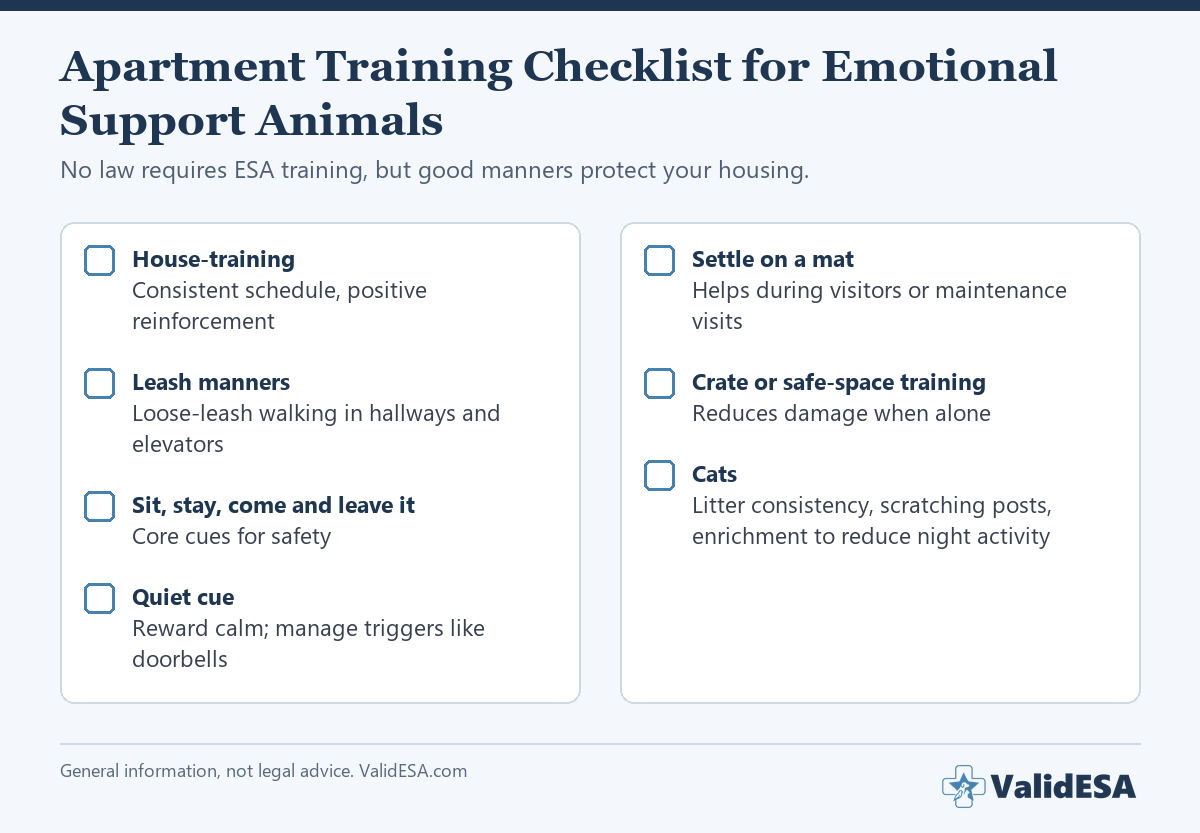
Checklist for emotional support animal training at home:
- House-training: consistent schedule, positive reinforcement
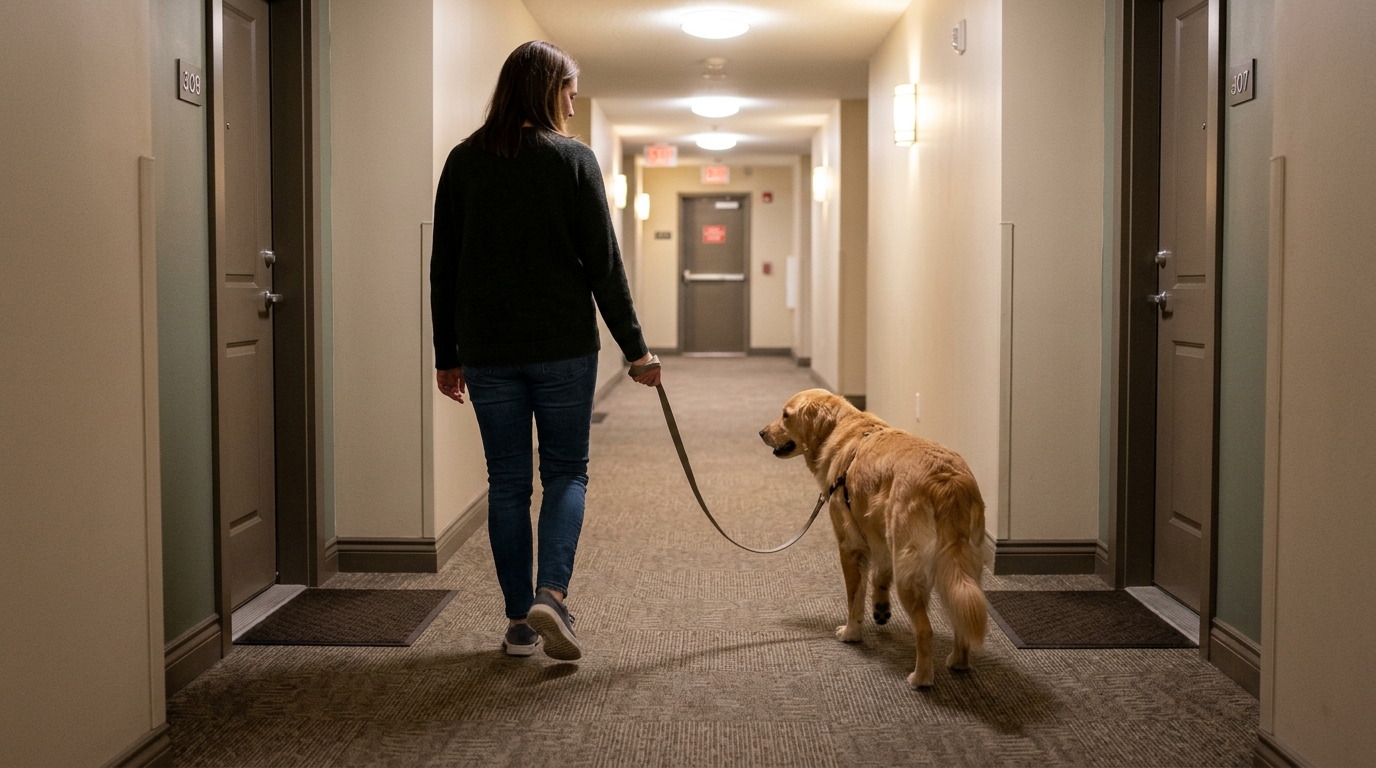
- Leash manners: loose-leash walking in hallways and elevators
- Sit, stay, come and leave it: core cues for safety
- Quiet cue: reward calm; manage triggers like doorbells
- Settle on a mat: helps during visitors or maintenance visits
- Crate or safe-space training: reduces damage when alone
- Cats: litter consistency, scratching posts, enrichment to reduce night activity
How do I train my ESA to be calm in an apartment? Short daily sessions, reward-based methods, exercise and enrichment, and gradual exposure to building noises. Work with a qualified trainer for persistent issues.
Training 'certificates': what they are and aren't
Does an ESA need a training certificate? No. "ESA training certificates" sold online have no legal effect. Programs like the AKC Canine Good Citizen test are optional, but they can be a nice way to show a landlord your dog is well-mannered. They're not required.
A 4-week apartment manners plan
Week | Focus |
|---|---|
1 | House-training schedule; name recognition; crate or safe space |
2 | Leash walking in hallways; sit and stay at doors and elevators |
3 | Quiet cue; settling on a mat; desensitize to doorbells and knocks |
4 | Practice with visitors; short alone-time sessions; review problem areas |
Keep sessions short (5–10 minutes), reward-based and consistent.
Behavior problems landlords notice most
- Barking or howling when alone: build alone time gradually; consider enrichment toys; consult a trainer for separation anxiety.
- Jumping on neighbors: teach "sit to greet"; use a leash in common areas.
- Accidents in common areas: stick to a schedule; clean thoroughly.
- Scratching doors or chewing trim: provide alternatives; supervise; use crates.
When to get professional help
Call a qualified trainer or veterinary behaviorist if you see:
- Growling, snapping or biting
- Severe separation anxiety such as destruction, self-injury or nonstop barking
- Sudden behavior changes, which can signal pain or illness
- Fear that prevents normal walks or daily life
Acting early protects your animal, your neighbors and your housing.
ESAs vs pets: behavior rules are the same
An approved ESA isn't exempt from reasonable building rules on leashes, waste, noise and common-area behavior. Landlords can enforce those rules the same way they would for any resident's animal, as long as the rules don't undermine the accommodation itself.
Cats, rabbits and other ESAs
Training looks different for non-dogs:
- Cats: litter consistency, scratching posts, play sessions to reduce nighttime activity
- Rabbits: litter training and chew-proofing cords
- Birds: noise management and cage cleanliness
Tips for puppies, rescues and anxious pets
- Puppies: expect chewing and accidents. Crate training, supervision and puppy classes help prevent damage claims.
- Rescues: go slow; document progress; ask a trainer about any fear or reactivity.
- Anxious pets: avoid punishment; use desensitization; consult a veterinarian about anxiety.
- Senior pets: watch for health-related behavior changes; see your vet.
Need an ESA letter for housing? Start your ESA assessment. Learn how to get an ESA letter.
Conclusion: emotional support animal training in a nutshell
Emotional support animal training isn't legally required, but good behavior is. Basic manners protect your housing, your neighbors and your animal. If your dog performs trained tasks for your disability, it may qualify as a psychiatric service dog with broader rights.
Frequently asked questions
Do emotional support animals need to be trained?
No. There's no legal training requirement for ESAs. They must still behave reasonably in housing, and owners are responsible for their behavior.
What is the difference between ESA and service dog training?
Service dogs must be individually trained to perform disability-related tasks and to behave in public. ESAs need no task training, only basic manners for housing.
Can a landlord remove an ESA that misbehaves?
Yes, if the specific animal poses a direct threat that can't be reduced, causes substantial damage, or is out of control and the owner doesn't take effective action.
How do I train my ESA to be calm in an apartment?
Use short, reward-based sessions, provide exercise and enrichment, practice settling on a mat, and gradually expose your pet to building noises. See a qualified trainer for persistent issues.
Does an ESA need a training certificate?
No. Online 'ESA training certificates' have no legal effect. Optional programs like the AKC Canine Good Citizen test can show good manners but aren't required.
Can my ESA be trained to become a service dog?
Only if it can be individually trained to perform tasks related to its handler's disability and behave reliably in public. Many dogs aren't suited to service work.
Does an ESA cat need training?
No legal training is required, but litter habits, scratching-post use and calm behavior help in rentals.
Will training help my ESA housing request?
Training isn't required for ESAs, but good behavior reduces landlord concerns. Since HUD's 2026 change, genuinely task-trained animals get stronger federal housing protection.
Can a landlord require my ESA to pass a behavior test?
Generally, landlords shouldn't impose training or testing requirements on assistance animals, but they can act if a specific animal poses a direct threat or causes substantial damage.
Is crate training okay for an ESA?
Yes. Crate or safe-space training is a humane, common way to prevent damage and give your pet a calm retreat when introduced gradually.
Does an ESA need to be leashed in common areas?
Building rules requiring leashes in common areas generally apply to ESAs like other animals, as long as they don't undermine the accommodation.
How long does basic apartment training take?
Many pets learn basic apartment manners in four to eight weeks of consistent, short daily sessions, though puppies and rescues may need longer.
Sources
- ADA regulations, 28 C.F.R. §§ 36.104, 36.302(c)
- Fair Housing Act, 42 U.S.C. § 3604(f)(9) (direct threat)
- HUD FHEO assistance-animal rescission (September 17, 2025); Holland & Knight (June 2026): hklaw.com
- American Kennel Club, Canine Good Citizen program: akc.org
This article is for general information and is not legal or medical advice. Laws and agency enforcement policies change; check the cited sources or speak with a qualified attorney or licensed clinician about your situation.