
Emotional Support Animal for Depression: Does Depression Qualify, and How Does an ESA Help?
By the ValidESA Editorial Team · Reviewed by Dr Anita Sanders · Last updated:
Quick answer (AI snippet)
Yes, you can get an emotional support animal for depression if a licensed clinician finds that your depression is a disability and that an animal helps with a related need. ESAs can support routine, activity and connection. An ESA letter mainly helps with housing, and it does not need to name your diagnosis.
Key takeaways
- Depression can qualify for an ESA when it substantially limits daily life.
- A licensed clinician decides; there is no automatic approval.
- Pets may support routine, activity and social contact, but research on mental-health benefits is mixed.
- ADHD and co-occurring conditions can also qualify.
- Your ESA letter confirms a disability and a need - not your diagnosis.
Can you get an emotional support animal for depression?
Can you get an emotional support animal for depression? Yes. Depression is one of the most common conditions behind ESA requests. Under fair housing rules, what matters is whether your depression is a disability - a condition that substantially limits a major life activity - and whether an animal helps with a need related to it. A licensed mental health professional makes that assessment.
How an ESA for depression may help
An ESA for depression doesn't treat depression, and it isn't a substitute for therapy or medication. People who use support animals for depression often describe benefits such as:
- Routine: feeding, walking and care create structure on hard days
- Activity: dogs in particular encourage getting outside and moving
- Connection: animals can reduce feelings of isolation and prompt contact with other people
- Comfort and touch during low moods
- A sense of purpose and responsibility
Research on pets and depressive symptoms is mixed: some studies find benefits, others find little difference, and outcomes depend on the person and the animal. That is why a clinician's individual assessment matters more than general claims.
What "qualifying" means for depression
A diagnosis alone doesn't decide it. A clinician looks at how depression affects your daily functioning - sleep, work, concentration, self-care, relationships - and whether the animal's presence helps with those limits. Major depressive disorder, persistent depressive disorder (dysthymia) and depression linked to other conditions can all qualify. For the full list, see qualifying mental health conditions.
ADHD, anxiety and co-occurring conditions
Depression often appears alongside anxiety or ADHD. An ADHD emotional support dog can help with routine and time structure, and ADHD can itself qualify when it substantially limits daily life. If panic or anxiety symptoms are severe and you need help in public places, a trained psychiatric service dog may be worth considering - see service dog for anxiety.
Getting evaluated
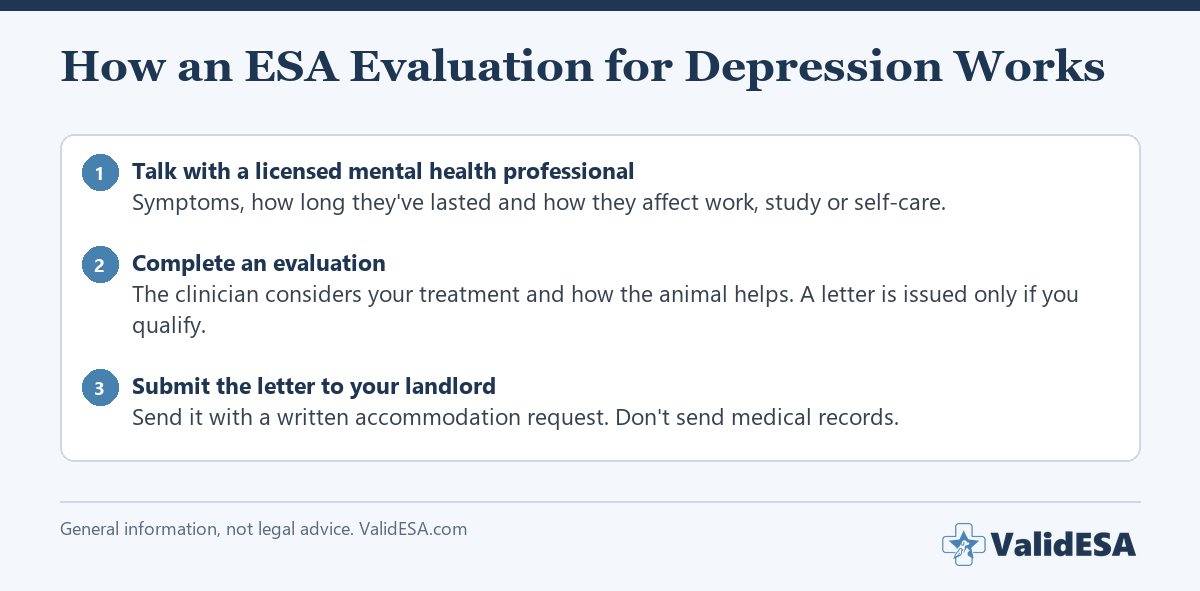
- Talk to your current therapist, psychiatrist or doctor if you have one.
- If not, use a service with licensed providers in your state.
- Expect questions about symptoms, how long you have had them, how they affect your life and how the animal helps.
- The clinician decides whether to issue a letter.
Learn more about license types in who can write an ESA letter, or start with a free assessment.
Privacy: what your letter does - and doesn't - say
An ESA letter should state that you have a disability and that the animal helps with a disability-related need. It does not need to name depression or any other diagnosis, and a landlord shouldn't ask for your medical records. The letter is confirmation, not a case file.
Choosing an animal when you have depression
- Be realistic about energy levels on bad days - a cat or small pet may suit you better than a high-energy dog.
- Think about cost and time over the animal's lifetime.
- Line up a back-up carer for times you can't manage.
- Consider adopting an adult animal with a known temperament.
Compare options in types of emotional support animals.
What an evaluation for depression usually covers
- Your symptoms: mood, sleep, energy, appetite, concentration
- How long they have lasted and how they affect work, study or self-care
- Current treatment, if any
- How the animal helps - routine, activity, comfort, connection
- Your housing situation and why you are requesting a letter
Answer honestly. A clinician who decides you don't meet the standard is protecting the credibility of your request, not judging you.
Seasonal and postpartum depression
Seasonal affective disorder and postpartum depression can qualify when they substantially limit daily life during the periods they occur. A clinician will consider how often episodes recur and how severe they are. An animal's routine can be especially valuable during darker months.
ESA, service dog or therapy dog for depression?
ESA | Psychiatric service dog | Therapy dog | |
|---|---|---|---|
Training | None required | Task-trained | Trained for visits |
Helps whom | You | You | Many people |
Public access | No | Yes | No |
Typical use for depression | Routine and comfort at home | Tasks such as interrupting self-harm or medication reminders | Visits in hospitals or schools |
Housing protection for an ESA for depression
An ESA letter supports a reasonable-accommodation request to a landlord. Since HUD's May 22, 2026 change, federal enforcement for untrained animals is narrower, but tenants can still sue under the Fair Housing Act and many state laws still protect ESAs. A clear, verifiable letter from a licensed clinician licensed in your state is the strongest document you can have.
Getting support beyond the animal
- Keep up with therapy or medication if prescribed.
- Peer support groups (in person or online)
- Sleep, movement and daylight routines - which an animal can help anchor
- Crisis support: call or text 988
Signs an ESA may help your depression
- Your days lack structure and you struggle to get up or go out.
- You feel isolated, and an animal prompts contact with others.
- Touch and companionship ease low moods.
- You have the energy and resources to care for an animal on most days.
If caring for an animal would add stress on bad days, consider a lower-maintenance animal or wait until you have more support.
Talking to your current therapist about an ESA
- Raise it directly: explain what the animal does for your mood and routine.
- Ask whether they write ESA letters or prefer to refer you.
- Be ready to discuss how depression affects your daily functioning.
- If they decline, ask why, and whether another clinician might assess you.
What happens if you don't qualify
If a clinician decides you don't meet the standard, no letter is issued. That isn't a judgment of your experience; it means the clinician couldn't confirm a disability-related need for the animal. You can keep a pet where your lease allows, revisit the question later, or ask another licensed professional for a second opinion.
A day with an ESA when you have depression
Time | What the animal adds |
|---|---|
Morning | A reason to get up: feeding and a short walk |
Midday | A break outdoors or a moment of play |
Afternoon | Company while you work or rest |
Evening | Routine: dinner, grooming, a walk |
Night | Comfort and a predictable bedtime |
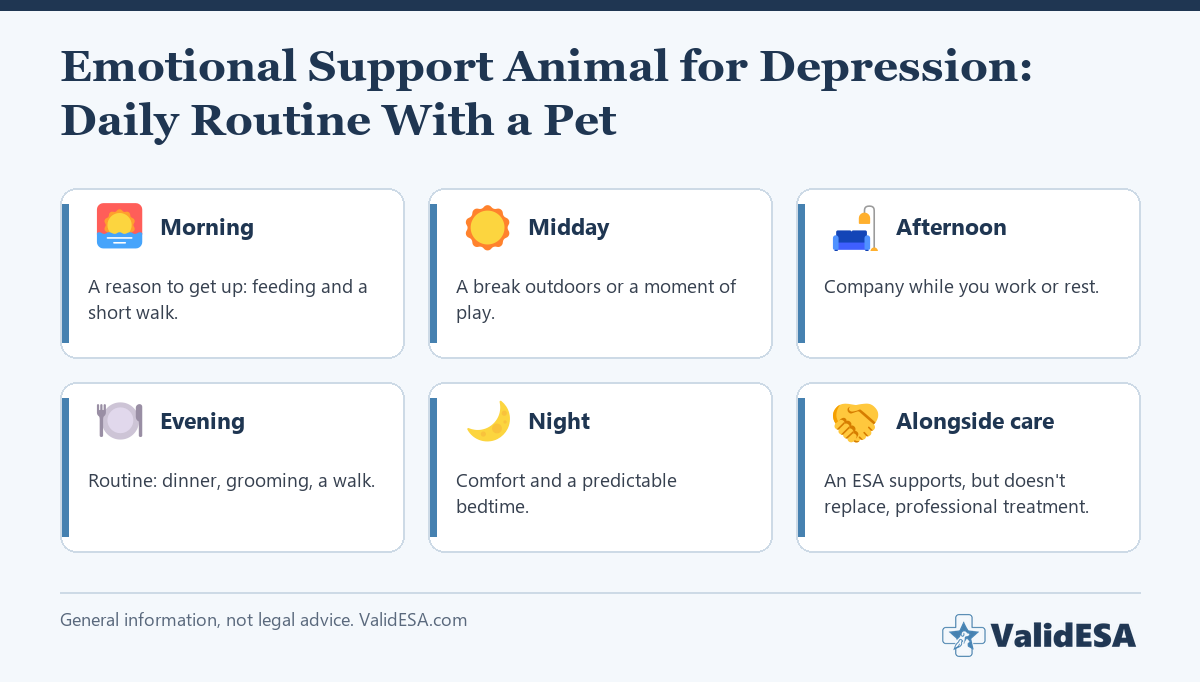
The point is structure. Even small, regular tasks can make a hard day more manageable.
Depression in teens and college students
Students living in dorms can request an ESA through the university's housing accommodation process; dorms are housing under the Fair Housing Act and Section 504. Parents and students should start the request early in the term and use a clinician licensed where the student lives.
When an ESA isn't the right fit
If caring for an animal would add stress, or if your housing doesn't allow it and you have no legal route to an accommodation, an ESA may not help. Treatment, peer support and other strategies remain the foundation. If you are in crisis, call or text 988 in the U.S.
Conclusion: an emotional support animal for depression
An emotional support animal for depression is a real option when a licensed clinician finds that depression limits your daily life and an animal helps. Treat it as one part of a wider plan, choose an animal you can care for, and remember that your letter protects your housing request without disclosing your diagnosis.
Frequently asked questions
Does depression qualify for an ESA?
It can. If a licensed clinician finds your depression is a disability that substantially limits daily life and an animal helps with a related need, you may qualify.
What is the best animal for depression?
There is no single best animal. Dogs encourage activity and routine; cats and small pets need less energy. Choose one that fits your life.
Does ADHD qualify for an emotional support animal?
ADHD can qualify when it substantially limits daily functioning and an animal helps with a related need. A clinician decides.
Will my landlord know my diagnosis?
No. An ESA letter confirms a disability and a disability-related need without naming a diagnosis, and landlords shouldn't ask for medical records.
How do I ask my therapist for an ESA letter?
Explain how the animal helps with your symptoms and ask whether they are comfortable assessing you for an ESA. Some therapists write letters; others refer you elsewhere.
Do I need a diagnosis to get an ESA letter for depression?
A clinician assesses whether you have a disability-related need; the letter itself doesn't name a diagnosis. You don't need a prior diagnosis before the evaluation.
Can I get an ESA for depression online?
Yes, through a service whose clinicians are licensed in your state and conduct a real evaluation.
Can an ESA replace therapy for depression?
No. An ESA can support routine and comfort, but it isn't a treatment. Keep up with therapy or medication if prescribed.
Is a dog or a cat better as an ESA for depression?
Dogs encourage activity and routine; cats need less energy and suit smaller spaces. The better choice depends on your energy, home and preferences.
How long does an ESA letter for depression last?
Letters don't carry an official expiry date, but many landlords want one dated within the last 12 months, so plan to renew yearly.
Can a student get an ESA for depression in a dorm?
Often yes. Dorms are housing under the Fair Housing Act and Section 504, so students can request an ESA through the university's accommodation process.
Sources
- National Institute of Mental Health, Depression: nimh.nih.gov
- Fair Housing Act, 42 U.S.C. § 3602(h) (disability definition) and § 3604(f)
- Peer-reviewed research on pet ownership and depressive symptoms (PubMed Central) — Brooks et al. (2018), BMC Psychiatry 18:31.
- 988 Suicide & Crisis Lifeline: 988lifeline.org
This article is for general information and is not legal or medical advice. Laws and agency enforcement policies change; check the cited sources or speak with a qualified attorney or licensed clinician about your situation.