
Can You Get an ESA After You Move In? How to Request an ESA Mid-Lease
By the ValidESA Editorial Team · Reviewed by Dr Anita Sanders · Last updated:
Quick answer (AI snippet)
Yes. You can ask for an emotional support animal as a reasonable accommodation at any point in a tenancy, including after you move in or sign a no-pets lease. Send a written request with a letter from a licensed clinician, answer reasonable questions, and keep records. Landlords can still evaluate the specific animal.
Key takeaways
- Nothing in the Fair Housing Act limits accommodation requests to before move-in.
- A no-pets clause in your lease doesn't block a later request.
- Put the request in writing and attach a clinician's letter - not medical records.
- Don't bring the animal home until the request is approved, if you can avoid it.
- Federal enforcement for untrained ESAs narrowed in 2026; state law often fills the gap.
Can I get an ESA after I move in?
Can I get an ESA after I move in? Yes. Disabilities and needs change, and the Fair Housing Act's reasonable-accommodation rule (42 U.S.C. § 3604(f)(3)(B)) has no "before move-in" deadline. You can ask during a lease, at renewal or even if you signed a no-pets clause. The landlord must consider the request on its merits, although since May 22, 2026 HUD enforces the rule federally only for trained animals - see Fair Housing Act and emotional support animals.
Why a no-pets lease doesn't end the conversation
A reasonable accommodation is, by definition, an exception to a rule or policy - including a lease term. Signing a no-pets lease doesn't waive your right to ask. What it does mean is that you should follow the process carefully and wait for approval before bringing the animal home, so the landlord can't treat it as a lease violation.
Step-by-step: requesting an ESA mid-lease
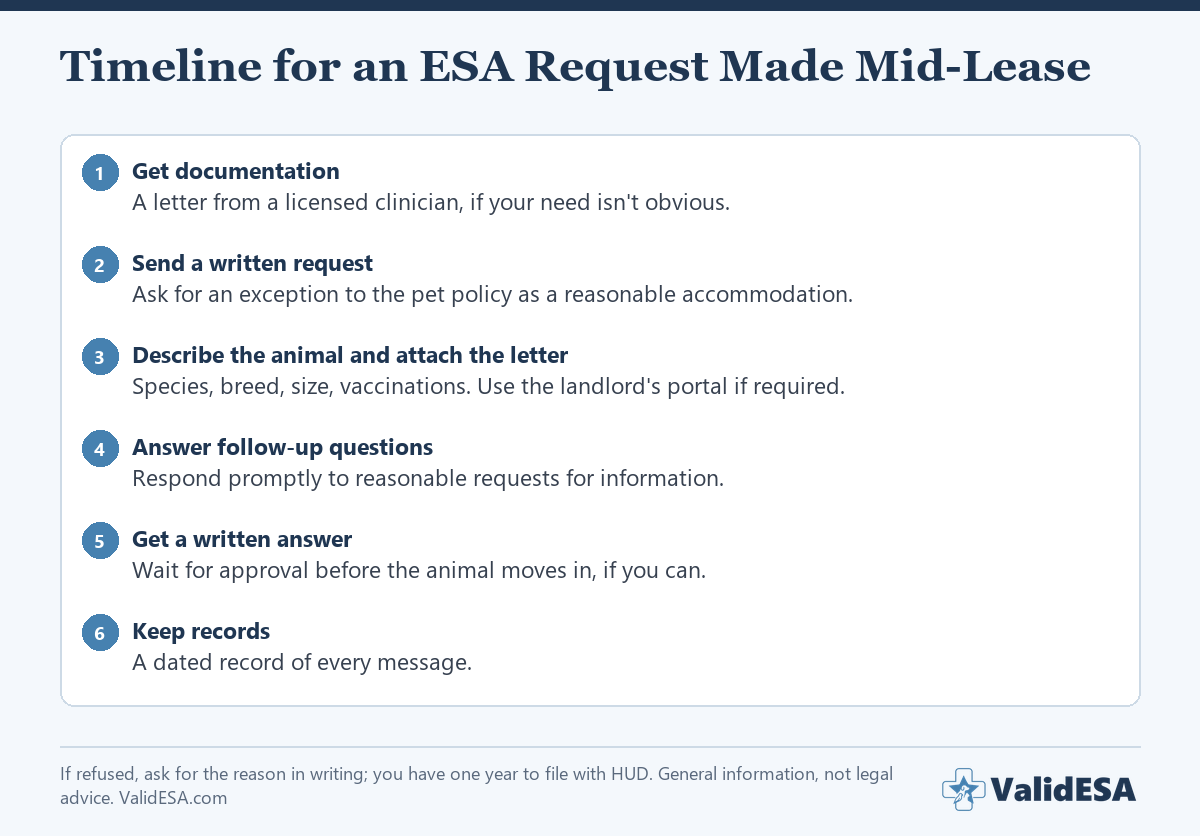
- Get documentation. If your disability or need isn't obvious, get a letter from a licensed clinician - get an ESA letter.
- Write to your landlord or property manager. Say you have a disability-related need for an emotional support animal and are requesting an exception to the pet policy as a reasonable accommodation. See ESA accommodation request wording.
- Describe the animal: species, breed, size and that it is vaccinated and licensed where required.
- Attach the letter, not your medical records.
- Use the landlord's portal if they require one (some use PetScreening), but keep your own copy.
- Wait for a written answer before the animal moves in, if you can.
- Keep a dated record of every message.
What the landlord can ask for
- Reliable documentation of a disability-related need, when it isn't obvious
- Confirmation that the clinician and license are real - landlords can verify a letter
- Basic information about the animal and proof of local licensing or vaccination
They should not demand your diagnosis, therapy notes or a paid "certificate." For what a strong letter contains, see ESA letter for housing.
How long does the landlord have to respond?
Federal law sets no fixed deadline, but an unreasonable delay can be treated as a denial. Follow up in writing if you hear nothing within about 10 business days. Some states set their own procedures; check your state's rules.
Fees, deposits and existing pet clauses
Many state laws still require landlords to waive pet fees, pet rent and pet deposits for ESAs, while the federal position for untrained ESAs became uncertain after HUD's May 2026 change. You remain responsible for any damage the animal causes. If your lease already lists pet rent for a different pet, the ESA request is a separate question.
Common mid-lease situations
Situation | What usually happens |
|---|---|
New diagnosis or worsening symptoms mid-lease | Request as normal; timing doesn't matter |
You already have the animal without permission | Request immediately and be candid; the landlord may still raise the lease violation |
Lease renewal coming up | Request before or at renewal; the landlord can't refuse to renew because of a lawful request |
Roommate objects (allergies) | The landlord weighs both needs; alternatives may be discussed |
Building is owner-occupied with 4 or fewer units | May be exempt from the FHA; state law may still apply |
Retaliation
The Fair Housing Act makes it unlawful to coerce, intimidate, threaten or interfere with anyone for exercising fair housing rights (42 U.S.C. § 3617). Many states also protect tenants from retaliatory rent increases or non-renewal. Keep records if you notice a change in treatment after your request.
Sample wording for a mid-lease request
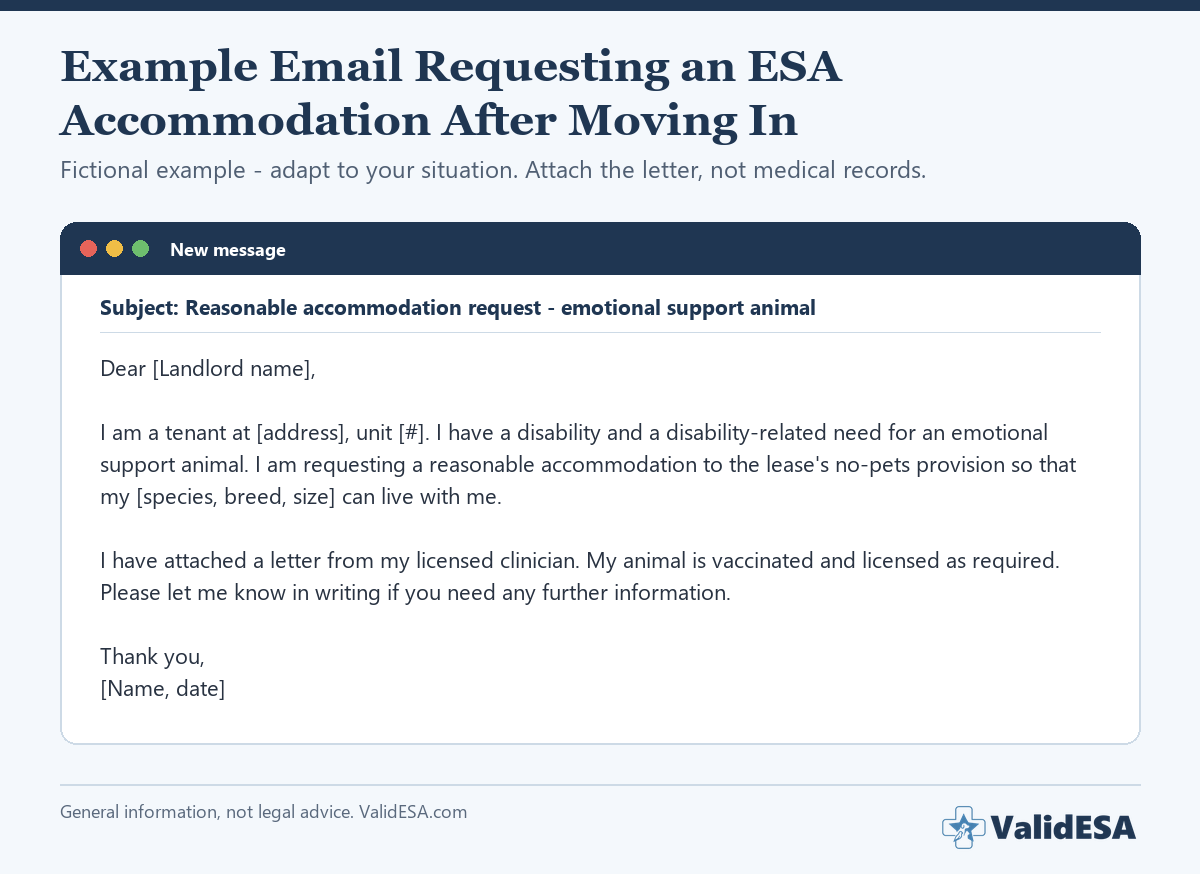
Example (fictional - adapt to your situation)
- Dear [Landlord name],
- I am a tenant at [address], unit [#]. I have a disability and a disability-related need for an emotional support animal. I am requesting a reasonable accommodation to the lease's no-pets provision so that my [species, breed, size] can live with me.
- I have attached a letter from my licensed clinician. My animal is vaccinated and licensed as required. Please let me know in writing if you need any further information.
- Thank you, [Name, date]
More request wording is available on our ESA letter template page.
If you already have the animal
If an animal is already living with you without permission, send the request immediately and be candid. A landlord may still raise the earlier lease violation, but a timely, documented request puts you in a much better position than waiting to be discovered.
Mid-lease requests in college and subsidized housing
University housing and federally assisted housing are covered by the Fair Housing Act and Section 504, and most have written accommodation procedures. Ask the housing office or public housing agency for its form; you can usually submit a request mid-term or mid-lease.
Mistakes to avoid
- Moving the animal in before asking
- Sending medical records instead of a letter
- Making the request only verbally
- Ignoring the landlord's reasonable follow-up questions
What changed in 2026 for mid-lease requests
HUD's May 22, 2026 memo rescinded its 2020 guidance, which had told landlords to consider ESA requests at any time and without pet fees. The statute still has no timing limit, but federal enforcement for untrained ESAs now runs mainly through private lawsuits. In states such as California, state law continues to require landlords to consider the request and generally to waive pet fees.
If your request is refused
- Ask for the reason in writing.
- Fix fixable problems (missing license details, an old letter).
- Consider a workable alternative the landlord proposes.
- Contact a local fair housing organization or your state civil-rights agency; you have one year to file with HUD and two years to sue under the FHA.
For the full list of lawful and unlawful reasons, read can a landlord deny an emotional support animal.
Get your ESA letter before you submit the request
Conclusion: getting an ESA after you move in
You can request an ESA after you move in, even under a no-pets lease. Get a letter from a licensed clinician, put the request in writing, wait for approval if you can and keep records. If the answer is no, ask why in writing and get local fair housing help.
Frequently asked questions
Can I get an ESA after signing a lease?
Yes. A reasonable accommodation can be requested at any time during a tenancy, including after signing a no-pets lease.
Can a landlord evict me for getting an ESA mid-lease?
A landlord shouldn't retaliate against a lawful accommodation request. Bringing an animal home before approval can create a lease issue, so request first and wait for an answer if you can.
How long does a landlord have to respond to an ESA request?
Federal law sets no fixed deadline, but an unreasonable delay can count as a denial. Some states set their own timelines.
Do I have to pay pet rent if my ESA comes later?
It depends on your state. Many state laws still require landlords to waive pet fees for ESAs; you remain liable for damage.
What if my lease says no pets?
A no-pets clause is exactly the kind of rule an accommodation request asks the landlord to waive. It doesn't stop you from asking.
Do I need a new ESA letter if I move to a new unit in the same building?
Usually not if the letter is current, but the landlord may ask you to confirm the accommodation for the new unit. Many landlords expect a letter dated within the last year.
Can my landlord make me use an online portal?
Many landlords use screening portals such as PetScreening. You can usually use the portal, but keep your own copy of the request and letter.
Can a landlord raise my rent after an ESA request?
Raising rent because of a lawful accommodation request can be retaliation under the FHA and many state laws. Keep records and seek fair housing help if it happens.
Sources
- Fair Housing Act, 42 U.S.C. §§ 3604(f)(3)(B), 3610, 3613, 3617
- 24 C.F.R. § 100.204
- HUD FHEO memo rescinding FHEO-2020-01 (May 22, 2026)
- State fair housing agency guidance (see /all-states)
This article is for general information and is not legal or medical advice. Laws and agency enforcement policies change; check the cited sources or speak with a qualified attorney or licensed clinician about your situation.