
Can a Nurse, RN or Nurse Practitioner Write an ESA Letter? Who Is Qualified (by License Type)
By the ValidESA Editorial Team · Reviewed by Dr Anita Sanders · Last updated:
Quick answer (AI snippet)
A nurse practitioner (NP/APRN) can often write an ESA letter, if their state scope of practice allows them to assess mental health conditions and they've evaluated you. A registered nurse (RN) generally can't on their own, because RNs typically don't diagnose. Psychologists, psychiatrists, LCSWs, LPCs and LMFTs are the most common ESA letter writers.
Key takeaways
- Nurse practitioners can often write ESA letters within their state scope of practice, especially psychiatric NPs (PMHNPs).
- Registered nurses generally can't write an ESA letter alone, because diagnosing and independently assessing disability is usually outside RN scope.
- Licensed mental health professionals (psychologists, psychiatrists, LCSWs, LPCs, LMFTs) are the most common, and most widely accepted, ESA letter writers.
- The clinician should be licensed in the state where you live. California requires it for emotional support dog letters.
- Always verify a clinician's license on the state board website.
Short answer
Can a nurse write an ESA letter? It depends on the type of nurse:
- Nurse practitioner (NP, APRN, PMHNP): often yes, within their state scope of practice, after evaluating you.
- Registered nurse (RN): generally no, not on their own.
- Licensed practical/vocational nurse (LPN/LVN): no.
The most widely accepted ESA letters come from licensed mental health professionals (LMHPs): psychologists, psychiatrists, licensed clinical social workers, licensed professional counselors and marriage and family therapists.
Who can provide ESA documentation?
No federal statute lists who may sign an ESA letter. Under the Fair Housing Act, a landlord may ask for reliable documentation of a disability and a disability-related need when they aren't obvious. HUD's former guidance (FHEO-2020-01) described reliable documentation as coming from a health care professional with personal knowledge of the person's condition. HUD rescinded that guidance on September 17, 2025, but the reliability principle still drives how landlords and courts evaluate letters.
Several states now spell out who can sign an ESA letter:
- California (Health & Safety Code § 122318): for emotional support dogs, a "health care practitioner" with an active license in the jurisdiction where the client is located, a 30-day client relationship and a clinical evaluation.
- Florida (§ 760.27): licensed health care practitioners, including telehealth and similarly licensed out-of-state practitioners in good standing, who have personal knowledge of the person's disability.
- Montana (HB 703, 2023): a provider must have a client-provider relationship for at least 30 days and complete a clinical evaluation.
License-by-license table
License | Can typically write an ESA letter? | Notes |
|---|---|---|
Psychiatrist (MD/DO) | Yes | Physician specializing in mental health |
Physician (MD/DO), any specialty | Often yes | If they know your condition; many defer to mental health specialists |
Psychologist (PhD/PsyD) | Yes | Licensed to assess and diagnose mental health conditions |
Nurse practitioner (NP/APRN; PMHNP) | Often yes | Within state scope; psychiatric NPs are best suited |
Physician assistant (PA) | Sometimes | Depends on state scope and supervision/collaboration rules |
LCSW / LICSW | Yes | Clinical social workers diagnose and treat mental health conditions |
LPC / LPCC / LMHC / LCMHC | Yes, in most states | Scope varies slightly by state |
LMFT | Yes, in most states | Scope varies by state |
Registered nurse (RN) | Generally no | Not licensed to independently diagnose |
LPN / LVN | No | Practices under supervision |
Pre-licensed associates/interns | Sometimes | California's BBS says AB 468 applies to registered associates too; supervision rules apply |
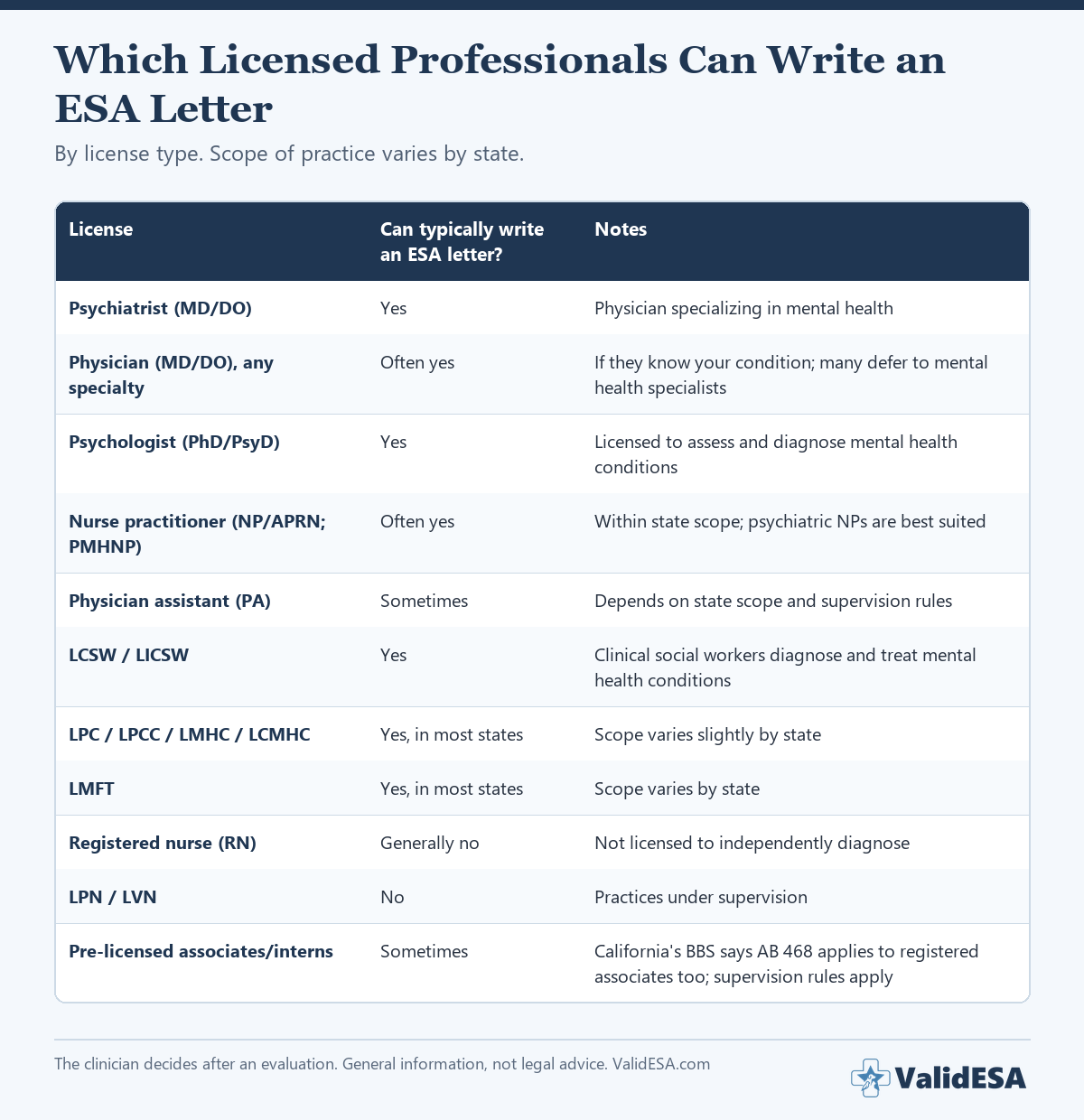
*Scope of practice varies by state. Confirm with your state's licensing board.*
An LMHP ESA letter, one from a licensed mental health professional, is the most widely accepted form because these clinicians specialize in the conditions ESAs help with.
Why RNs usually can't write the letter on their own
Can an RN write an ESA letter? Generally not as the sole author. An ESA letter confirms that you have a disability and a disability-related need for an animal. That's an independent clinical assessment. Registered nurses are licensed to assess and care for patients, but in most states they don't diagnose mental health conditions or practice independently. An RN can help in other ways, such as coordinating care or referring you to an NP, physician or mental health professional who can evaluate you.
Nurse practitioners: what to know
- Psychiatric-mental health NPs (PMHNPs) are trained to diagnose and treat mental health conditions and are well suited to ESA evaluations.
- Family or primary care NPs may write a letter if they know your condition and it's within their scope. Some prefer to refer.
- Practice authority varies. In some states NPs practice independently; in others they practice under collaborative agreements with physicians. Either way, the NP must act within their scope.
Does the clinician need to be licensed in your state?
Can my ESA letter be from a different state? Usually you should use a clinician licensed where you live:
- Telehealth rules generally require a license in the state where the patient is located.
- California requires it for emotional support dog letters.
- Florida accepts similarly licensed out-of-state practitioners in good standing with personal knowledge of your disability.
- Landlords commonly question out-of-state letters.
Do ESA letters work in all states? A valid letter works anywhere the clinician is licensed to treat you. If you move, you'll usually need a new letter from a clinician licensed in your new state. Some states, including California, Florida, Montana, Iowa and Louisiana, have extra rules. See B26 (ESA laws by state).
Real-world examples
- Your primary care NP manages your anxiety medication. Your NP knows your condition and, within your state's scope, may write the letter. Many psychiatric NPs routinely do.
- Your RN case manager wants to help. The RN can't sign the letter alone but can refer you to the NP, physician or therapist on your care team.
- You see an LPC by telehealth who's licensed in another state. Most landlords and telehealth rules expect a clinician licensed where you live. Ask for a referral to an in-state clinician.
- You live in California and need a letter for your dog. The practitioner must be licensed in California, have a 30-day client relationship and complete a clinical evaluation.
What the letter should look like, whoever signs it
Regardless of license type, a strong letter includes letterhead, the clinician's name, license type, license number and state (plus license effective date for California dog letters), date, signature, and statements of disability and disability-related need. It doesn't include your diagnosis.
How to verify a clinician's license
- Get the clinician's full name, license type and number from the letter.
- Go to the state licensing board: the nursing board for NPs and RNs (or Nursys.com for multi-state nurse license lookups), the medical board for physicians, and the behavioral health or psychology boards for others.
- Confirm the license is active, in your state, and has no relevant discipline.
- Save a screenshot.
See how to verify an ESA letter and our licensed providers.
Get evaluated by a clinician licensed in your state. Start your assessment.
Conclusion: can a nurse write an ESA letter?
Can a nurse write an ESA letter? A nurse practitioner often can, within state scope, after evaluating you. A registered nurse generally can't on their own. For the most widely accepted letter, choose a licensed mental health professional licensed in your state, and verify their license.
Related reading
Fair housing and emotional support animals
Frequently asked questions
Can a registered nurse write an ESA letter?
Generally not on their own. RNs usually aren't licensed to independently diagnose mental health conditions, which an ESA evaluation requires. An RN can refer you to an NP, physician or mental health professional.
Can a nurse practitioner write an ESA letter?
Often yes, if their state scope of practice allows them to assess and diagnose the condition and they've evaluated you. Psychiatric-mental health NPs are especially well suited.
Which licensed professionals can write ESA letters?
Most commonly psychologists, psychiatrists, LCSWs, LPCs/LMHCs and LMFTs. Physicians, nurse practitioners and some physician assistants may also write them within their state scope.
Can my ESA letter come from a clinician in another state?
It's safest to use a clinician licensed where you live. Telehealth rules usually require it, California requires it for emotional support dog letters, and landlords often question out-of-state letters.
Sources
- California Health & Safety Code § 122318 (AB 468); Board of Behavioral Sciences AB 468 FAQ: bbs.ca.gov
- Florida Statutes § 760.27
- Montana HB 703 (2023), bill text: leg.mt.gov; Montana Free Press Capitol Tracker
- HUD FHEO-2020-01 (rescinded September 17, 2025); Holland & Knight (June 2026): hklaw.com
- Nursys license verification: nursys.com; state licensing boards
- Fair Housing Act, 42 U.S.C. § 3604(f)(3)(B)
This article is for general information and is not legal or medical advice. Laws and agency enforcement policies change; check the cited sources or speak with a qualified attorney or licensed clinician about your situation.